
From Strategy To Sustainable Competitive Edge
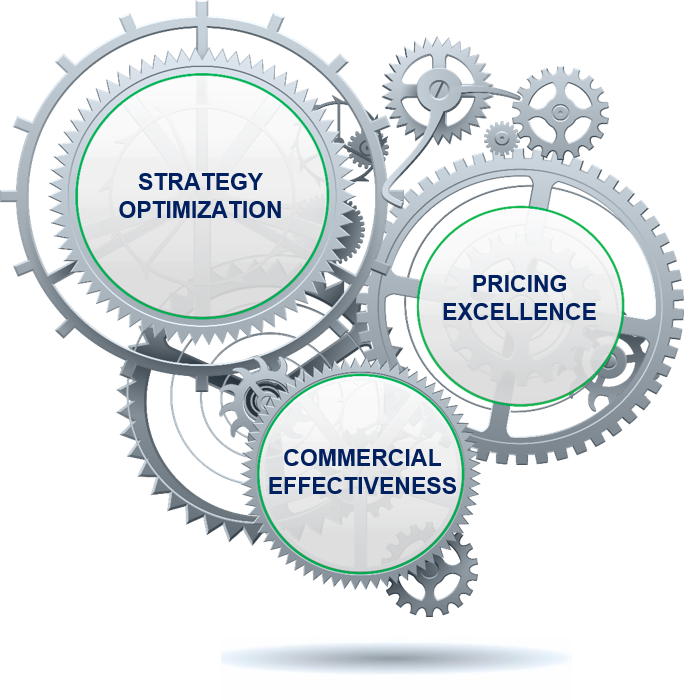

What Four International Executive Forums Reveal About the Next Stage of Commercial Transformation
Executive perspectives from Singapore, Frankfurt, New York and Brussels on Strategy, Pricing, Commercial Execution, Data, Systems and AI
EXECUTIVE SUMMARY
Across industries, geographies and technology environments, organizations are investing heavily in data, digital platforms, analytics and Artificial Intelligence.
Yet one fundamental challenge remains.
Having more information does not automatically create better commercial decisions. Having better technology does not automatically create better commercial performance.
The real competitive advantage comes from connecting Strategy, Pricing and Commercial Execution into one coherent operating framework—supported by trusted data, integrated systems, disciplined governance and pragmatic AI.
Recent Stratence Partners participation in international executive forums in Singapore, Frankfurt, New York and Brussels has provided different perspectives on the same underlying transformation challenge.
1. In Singapore, discussions with pricing and strategy leaders reinforced the importance of moving beyond insight toward structured commercial decisions.
2. In Frankfurt, the debate showed how Pricing Excellence is increasingly evolving into a much broader Commercial Transformation agenda.
3. In New York, the discussion moved further toward the challenge of converting Commercial Transformation into a sustainable competitive capability.
4. And in Brussels, surrounded by one of the world’s largest business technology ecosystems, another question became particularly visible: how do organizations translate increasingly powerful operational systems into measurable commercial impact?
Different environments.
Different executive audiences.
Different starting points.
But a remarkably consistent strategic question:
How can organizations turn Strategy, Pricing, Data, Systems and AI into sustainable competitive advantage?
Our conclusion is clear.
The next stage of Commercial Transformation will not be defined by adding another isolated initiative, dashboard, system or AI application.
It will be defined by the organization’s ability to make the entire commercial system work as one.
1. THE COMMERCIAL CHALLENGE HAS CHANGED
For years, companies have improved individual parts of their commercial organizations.
· They have implemented CRM and ERP platforms.
· They have developed sophisticated analytics.
· They have redesigned pricing processes.
· They have invested in sales effectiveness.
· They have created data lakes, dashboards and increasingly powerful AI applications.
Individually, many of these initiatives create value.
The problem arises when they remain disconnected.
A pricing strategy that is not reflected in sales behavior remains a strategy.
A sophisticated analytical model that commercial teams cannot operationalize remains analysis.
A CRM containing large volumes of customer information does not automatically improve commercial decisions.
And AI applied to a fragmented commercial operating model can accelerate activity without resolving the structural weaknesses underneath it.
The competitive question has therefore evolved.
It is no longer simply:
“How do we improve Pricing?”
or:
“How do we use AI?”
It is:
“How do we connect Strategy, Pricing and Commercial Execution, supported by Data, Systems and AI, into a disciplined decision and execution architecture?”
That is the challenge behind Commercial Transformation.
2. SINGAPORE: FROM INSIGHT TO STRUCTURED COMMERCIAL DECISIONS
At the Pricing Strategy Asia Summit in Singapore, Stratence Partners engaged with senior executives around one recurring challenge:
Organizations rarely suffer from a complete absence of information.
Many suffer from the opposite.
They have extensive market data, customer information, competitive intelligence, financial data, transactional histories and increasingly sophisticated analytics.

Yet executives can still struggle to convert this information into consistent commercial decisions.
Why?
Because insight and decision architecture are not the same thing.
An insight becomes economically valuable only when it changes a decision, behavior or action.
That requires clear mechanisms connecting intelligence with Strategy, Pricing and Commercial Execution.
The Singapore takeaway
The competitive advantage is not simply knowing more. It is turning knowledge into better decisions—and better decisions into consistent execution.
That means creating a continuous loop:
DATA → INTELLIGENCE → DECISION → EXECUTION → MARKET FEEDBACK → LEARNING
The organizations capable of operating this loop faster and more consistently can develop a structural advantage over competitors that still depend on fragmented analysis and individual judgment.
3. FRANKFURT: PRICING EXCELLENCE IS BECOMING COMMERCIAL TRANSFORMATION
At the Annual B2B Pricing & Commercial Excellence Summit Europe 2026 in Frankfurt, the conversations provided another important perspective.
Pricing remains one of the most powerful levers for improving profitability.
But the strongest executive discussions increasingly move beyond Pricing as a standalone capability.

The reason is structural.
Pricing depends on:
strategic segmentation;
customer and product economics;
value propositions;
competitive positioning;
commercial policies;
negotiation authority;
sales incentives;
data quality;
systems;
governance; and
execution in the field.
As organizations mature, the challenge becomes less about improving one commercial discipline and more about aligning the complete commercial system.
This also reveals another important reality.
Greater commercial maturity does not eliminate complexity. It exposes the next level of complexity.
Organizations that have already professionalized Pricing, Sales or Analytics often discover that their next performance constraint sits between functions.
The challenge becomes cross-functional.
The question therefore changes from:
“How do we improve Pricing?”
to:
“How do we make Strategy, Pricing and Commercial Execution work together?”
The Frankfurt takeaway
Pricing Excellence is increasingly evolving into Commercial Transformation.
Three observations were particularly relevant:
1. Pricing is becoming part of a broader transformation architecture.
Leading organizations increasingly recognize that sustainable pricing performance requires alignment across Strategy, Finance, Sales, Data and Systems.
2. Higher maturity creates new transformation challenges.
Once basic capabilities are established, performance improvement increasingly depends on integration, governance and execution discipline.
3. Cross-industry learning is becoming more valuable.
Organizations operating in different sectors often face structurally similar problems: margin leakage, fragmented decision-making, weak governance, inconsistent execution and disconnected data.
The industry context changes.
The underlying commercial architecture often does not.
4. NEW YORK: FROM COMMERCIAL TRANSFORMATION TO SUSTAINABLE COMPETITIVE EDGE
At the B2B Pricing & Commercial Excellence Summit America 2026 in New York, Stratence Partners participated as a Gold Partner, represented by Fernando Ventureira, Meir Spiegel and Greg Varner.

Fernando Ventureira’s Closing Keynote, “From Strategy to Sustainable Competitive Edge: Commercial Transformation in Practice,” addressed one of the central questions facing executive teams today:
How do organizations move from individual commercial improvement initiatives to a sustainable competitive capability?
Pricing remains a powerful profitability lever.
But Pricing cannot operate effectively in isolation.
Pricing decisions depend on strategic segmentation, customer and product economics, competitive positioning, value propositions, commercial policies, negotiation authority, incentives, data quality and execution in the field.
This means that sustainable Pricing Excellence increasingly requires a broader transformation architecture.
The New York takeaway
Commercial performance becomes sustainable when transformation is embedded into the operating model.
That requires:
reliable economic transparency;
clear commercial governance;
consistent decision rights;
structured processes;
aligned incentives;
actionable data;
systems supporting the required behaviors;
capability transfer; and
continuous measurement of market response and business impact.
The objective is not merely better pricing.
It is a stronger commercial organization.
And ultimately, a commercial organization capable of sustaining advantage without permanent external dependency.
5. BRUSSELS: TECHNOLOGY IS THE BACKBONE; NOT THE TRANSFORMATION
The context was different at Odoo Experience 2026 in Brussels.
Here, technology and business systems were naturally at the center of the conversation.
For Stratence Partners, represented by Fernando Ventureira and Eduardo Kühnel, this created an important perspective.

Organizations today have access to increasingly powerful operational platforms.
ERP, CRM, CPQ, Business Intelligence, workflow automation and AI can integrate enormous amounts of information and activity.
But technology cannot independently determine:
which customers should receive differentiated commercial treatment;
where genuine pricing power exists;
which discounts create value and which destroy margin;
how customer profitability should influence negotiations;
where sales authority should begin and end;
how incentives should reinforce strategy;
or how strategic priorities should translate into daily commercial decisions.
These are business architecture questions.
The Brussels takeaway
Technology provides the operational backbone. Commercial Transformation determines how that backbone creates economic value.
The strongest technology architecture cannot compensate for weak commercial governance, fragmented processes or unclear decision rights.
This also changes how organizations should approach AI.
The question should not be:
“Where can we add AI?”
It should be:
“Which commercial decisions need to become faster, more precise and more economically informed—and how can AI support them?”
That distinction matters.
AI should accelerate a strong commercial model rather than automate a fragmented one.
6. FOUR MARKETS. ONE STRUCTURAL MESSAGE.
Singapore emphasized the transition from insight to structured decision-making.
Frankfurt demonstrated how Pricing Excellence is evolving into broader Commercial Transformation.
New York addressed how that transformation becomes a sustainable competitive capability.
Brussels highlighted the role of technology and systems as enablers of economic performance.
Together, they point toward the same conclusion.
Commercial performance cannot be sustainably optimized function by function.
The commercial organization needs to operate as an integrated system.
That system connects:
STRATEGY
Where to compete, how to segment markets and customers, which value propositions to prioritize and where profitable growth opportunities exist.
↓
PRICING
How economic value is translated into price, conditions, discounts, rebates, contracts and negotiation boundaries.
↓
COMMERCIAL EXECUTION
How sales teams execute the strategy with the right authority, incentives, processes and customer interactions.
↓
DATA & SYSTEMS
How trusted information, analytics and integrated platforms support decisions across the commercial organization.
↓
AI
How intelligence and automation accelerate analysis, decision support and execution.
↓
MONITORING & GOVERNANCE
How actual market behavior and business performance continuously inform the next decision.
The result is not simply digitalization.
It is Commercial Transformation, AI Powered.
7. FIVE EXECUTIVE PRIORITIES EMERGING FOR 2027
The conversations across these four executive environments point toward five priorities that deserve particular attention.
1. CONNECT STRATEGY WITH EXECUTION
The gap between corporate strategy and field execution remains one of the largest sources of commercial underperformance.
Organizations need mechanisms that translate strategic priorities into concrete commercial rules, decisions and behaviors.
The organization must be able to answer:
Which customers matter most?
Where do we have genuine differentiation?
Where do we have pricing power?
Which products or services should receive commercial priority?
What decisions can commercial teams make autonomously?
Where is governance required?
Strategy becomes valuable only when it influences execution.
2. CREATE ECONOMIC TRANSPARENCY
Executives cannot manage what they cannot see.
True customer, product and transaction profitability -including full Gross-to-Net transparency- is fundamental to understanding where value is created or destroyed.
Revenue alone is not sufficient.
Average price is not sufficient.
Aggregate margin is not sufficient.
Organizations need enough granularity to identify structural leakage, inconsistent commercial conditions, uncontrolled exceptions and profitable growth opportunities.
Without economic transparency, many commercial decisions remain assumptions.
3. BUILD GOVERNANCE BEFORE AUTOMATION
Automation increases speed.
But accelerating poorly governed processes does not create Commercial Excellence.
Decision rights, policies, ownership and escalation mechanisms must be explicit before technology can scale them effectively.
This applies particularly to:
discount authority;
pricing exceptions;
tenders;
commercial conditions;
customer investments;
incentives;
approvals; and
negotiation boundaries.
Good technology can amplify a strong operating model.
It can also amplify a weak one.
4. TURN DATA INTO DECISIONS
More dashboards are not necessarily the answer.
The objective is to connect data and analytics directly with commercial decisions:
segmentation;
pricing;
negotiation;
portfolio management;
customer prioritization;
incentives;
resource allocation; and
strategic scenario planning.
The critical transformation is therefore:
DATA → INSIGHT → DECISION → EXECUTION
Not simply:
DATA → DASHBOARD
5. APPLY AI PRAGMATICALLY
AI creates the greatest value when embedded within real commercial workflows and decisions.
Its role should be practical:
accelerating data integration;
detecting opportunities;
supporting scenarios;
identifying anomalies;
translating analytical complexity into business language;
assisting commercial teams;
supporting negotiation preparation;
and improving decision speed and precision.
AI is an accelerator.
It is not a substitute for Commercial Transformation.
8. FROM TRANSFORMATION PROJECT TO PERMANENT CAPABILITY
One final lesson connects all four environments.
Commercial Transformation cannot be treated as a temporary consulting project.
The ultimate objective must be organizational autonomy.
That requires transferring capabilities into the business:
Best Practices;
governance;
processes;
methodologies;
analytical capabilities;
systems;
tools;
training;
coaching;
and decision disciplines.
When those capabilities become embedded, transformation stops being an initiative.
It becomes part of how the organization operates.
That is when competitive advantage becomes sustainable.
The objective is therefore not merely to improve performance during a transformation program.
It is to create an organization that can continue improving after the program has ended.
CONCLUSION
The executive conversations taking place across international markets are changing.
AI is increasingly present.
Technology is increasingly powerful.
Data is increasingly abundant.
Pricing capabilities are increasingly sophisticated.
But the fundamental business challenge remains remarkably consistent:
How do we make better commercial decisions—and execute them consistently?
Singapore demonstrated the importance of transforming insight into structured decisions.
Frankfurt showed how Pricing Excellence is becoming part of a broader Commercial Transformation agenda.
New York reinforced the need to turn transformation into sustainable competitive capability.
Brussels demonstrated why technology must support the commercial architecture rather than define it.
Four markets.
Four perspectives.
One structural message.
The organizations that lead the next stage of Commercial Transformation will not necessarily be those with the most technology, the most data or the largest number of AI initiatives.
They will be those that successfully connect them.
Strategy. Pricing. Commercial Execution. Data. Systems. AI. Governance. People.
Not as separate initiatives.
As one commercial system.
That is how organizations move from insight to action.
From activity to measurable impact.
And ultimately:
From Strategy to Sustainable Competitive Edge.
ABOUT STRATENCE PARTNERS
Stratence Partners is a global consulting firm specialized in Commercial Transformation, AI Powered, supporting CEOs and executive teams in turning strategy into measurable, scalable and sustainable performance impact.
With 25+ years of international experience, Stratence redesigns the full commercial framework of Strategy, Pricing and Execution, combining senior-level advisory with hands-on implementation.
As a collaborating firm of Andersen Consulting, Stratence operates within a broader end-to-end ecosystem, accelerating execution while reducing complexity and risk at scale.
Stratence does not optimize parts of Strategy, Pricing and Execution.
It fixes the entire framework… permanently.


Comments