
AI Will Not Replace Executive Judgment. It Will Make It More Important.

Artificial intelligence is changing how organizations make decisions. But it is not eliminating the need for executive judgment. It is changing what effective judgment requires.
Across industries, organizations are introducing increasingly sophisticated analytical capabilities to support forecasting, pricing, customer management and commercial operations.
AI can help executives process larger volumes of information, identify patterns that might otherwise remain hidden and evaluate potential courses of action more efficiently.
These developments create significant opportunities.
But they also raise a fundamental leadership question: When technology can generate more recommendations, who ensures that the organization makes the right decisions?
Better information is not the same as better decisions
One of the most important distinctions in modern commercial management is the difference between analytical capability and decision quality.
An organization may have access to advanced forecasting tools, sophisticated pricing models and detailed customer intelligence. Yet those capabilities do not automatically produce stronger financial results.
A pricing recommendation may optimize revenue while creating unintended consequences for customer relationships.
A sales forecast may identify an attractive growth opportunity without adequately accounting for the resources required to pursue it.
A commercial optimization model may identify potential efficiencies without understanding broader strategic priorities.
These are not necessarily failures of technology. They reflect the reality that business decisions involve objectives, constraints and trade-offs that extend beyond individual analytical models.
Executive judgment remains essential to interpreting those trade-offs and ensuring that decisions support the organization's overall direction.
The rise of the multidisciplinary executive
This challenge becomes particularly relevant as executive responsibilities grow increasingly interconnected.
The traditional C-suite structure has relied heavily on functional specialization. Finance, Sales, Marketing, Operations, Technology and Strategy have each developed their own expertise and decision-making processes.
Those capabilities remain indispensable. However, AI is increasing the potential speed and scale at which decisions influence other functions.
A change in pricing can affect demand, profitability and commercial execution. A strategic decision can alter the assumptions underlying analytical models. A technology investment can transform processes without necessarily improving the quality of commercial decisions.
Tomorrow's executives must therefore understand not only their own functional responsibilities, but also how decisions propagate across the enterprise.
This is one of the central questions associated with the rise of the multidisciplinary CXO.
AI Powered Commercial Transformation
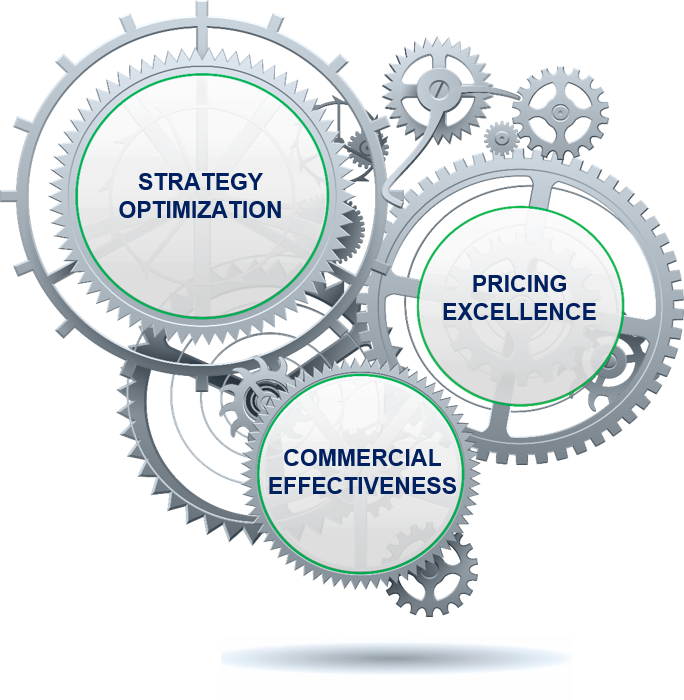
At Stratence Partners, we approach these challenges through an integrated model of Commercial Transformation — AI Powered.
Strategy Optimization establishes commercial direction, priorities and the choices required to achieve business objectives.
Pricing Excellence helps organizations translate value into profitable commercial decisions through appropriate analytical capabilities, governance and execution.
Commercial Effectiveness focuses on converting strategic and pricing decisions into consistent commercial performance.
These disciplines are supported by Data Management, Data Science and Integrated Commercial Systems, enabling organizations to connect information, decision-making and execution.
AI can strengthen this integrated framework by improving analytical depth, decision support and operational responsiveness. However, the objective is not technology adoption for its own sake.
The objective is stronger commercial decisions and measurable business performance.
From analytical intelligence to organizational intelligence
As organizations expand their use of AI, an important distinction will emerge between companies that deploy sophisticated tools and those that develop sophisticated decision-making capabilities.
The latter requires more than technology. It requires clearly defined strategic priorities, reliable data, appropriate governance, cross-functional collaboration and disciplined execution.
It also requires executives capable of asking the right questions.
What business outcome are we optimizing? Which trade-offs are acceptable? How will a decision affect other functions? Who is accountable for the result? And how will we know whether the decision created measurable value?
AI can support the answers. Leadership remains responsible for the questions and the consequences.
Bringing the conversation to Bangkok
On November 26, Javier Palazuelos, Senior Vice President APAC at Stratence Partners, will participate in the panel “The Rise of the ‘Super CXO’ (Multi-Role Leadership)” at NextGen CXO Week 2026 in Bangkok.
With more than 25 years of international experience across Business Transformation, Pricing & Revenue Management and Commercial Strategy, Javier brings a multidisciplinary commercial perspective to the discussion.
His participation provides an opportunity to explore the evolving demands placed on current and future executive leaders across APAC.
As AI becomes more deeply integrated into business processes, the importance of connecting strategy, economics, data and execution will continue to grow.
The most effective leaders will not necessarily be those who understand every technology in detail. They will be those who understand how technology, people and commercial decisions must work together to create enterprise value.
The future belongs to better decision-makers
Artificial intelligence can increase the speed, scale and sophistication of business analysis. But competitive advantage will depend on how organizations convert those capabilities into effective decisions.
This requires leadership teams that combine functional expertise with multidisciplinary understanding, strategic judgment and commercial execution.
The future of executive leadership is not about choosing between human judgment and artificial intelligence.
It is about combining both to make better decisions and deliver stronger business performance.
Event Information
NextGen CXO Week 2026 | November 25–26, 2026 | Hilton Bangkok Grande Asoke, Bangkok, Thailand
Javier Palazuelos | Senior Vice President APAC, Stratence Partners
Panel — November 26: The Rise of the “Super CXO” (Multi-Role Leadership)
Attending NextGen CXO Week 2026? Connect with Javier Palazuelos to discuss the evolving relationship between executive leadership, AI and commercial performance.


Comments