
Market Outlook 2026 | How Most Industries Will Win or Lose in an AI Accelerated Economy | By Fernando Ventureira, CEO – Stratence Partners

Executive Summary
By 2026, most industries will operate in an environment defined by structural volatility, sustained margin pressure, and permanent scrutiny on capital efficiency. Artificial Intelligence (AI) is accelerating these dynamics — amplifying both advantage and disadvantage. In this context, competitive differentiation will no longer come from strategy design alone, but from the ability to translate strategy into disciplined execution in the field, at speed and with certainty.
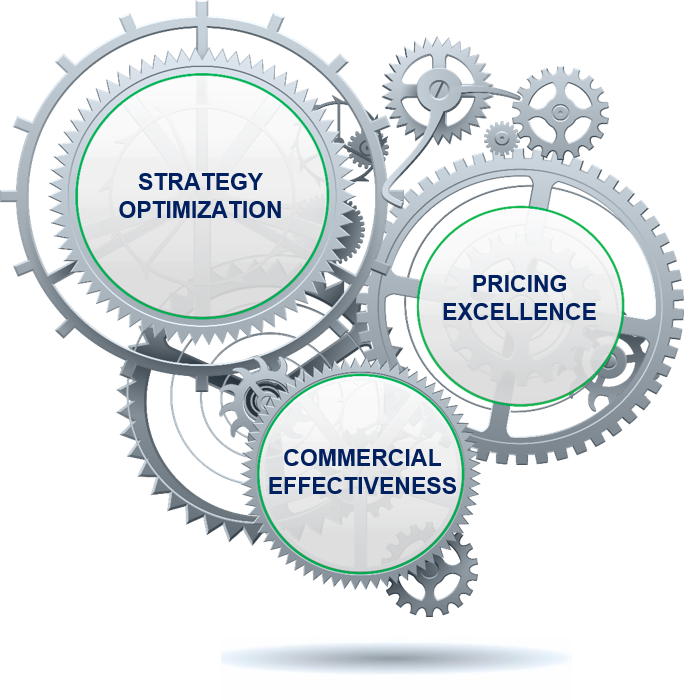
Organizations that succeed will be those that combine clear strategic intent, robust pricing and commercial governance, and AI-enabled execution capabilities into a single, coherent operating system. This whitepaper outlines why Commercial Excellence has become the primary driver of profitability and valuation, how AI accelerates decision-making and execution, and why end-to-end implementation capability is emerging as a decisive competitive advantage.
1. The 2026 Market Reality: Volatility as a Structural Condition
Volatility is no longer cyclical. For most industries, it has become a structural condition driven by geopolitical fragmentation, supply‑chain reconfiguration, regulatory pressure, and rapid technological change. Margin compression and capital constraints are no longer temporary challenges; they are defining features of the operating environment.
In this context, scale alone no longer protects performance. Competitive advantage increasingly depends on decision precision, execution velocity, outcome certainty, and the strength of the commercial engine. Organizations that continue to rely on static planning cycles, fragmented execution, and intuition‑based decisions will struggle to sustain returns.
2. Commercial Excellence as the Primary Profit and Valuation Driver
Across most industries, Commercial Excellence is emerging as the dominant driver of profitability, cash generation, and enterprise value. Years of inflation shocks, cost instability, and demand volatility have exposed the limitations of traditional commercial models.
Static strategies, disconnected sales organizations, and gut‑feel pricing decisions are being replaced by data‑driven strategic scenarios, real‑time sales governance, and disciplined value‑based pricing architectures. What was once considered advanced capability is rapidly becoming a baseline competitive requirement.
Importantly, Commercial Excellence is no longer confined to sales effectiveness. It now encompasses segmentation, route‑to‑market design, pricing governance, incentive systems, and customer profitability management—integrated into a single performance framework.
3. AI as an Accelerator, Not a Standalone Solution
Artificial Intelligence is not redefining competition on its own. Its real impact lies in acceleration. AI dramatically increases the speed, quality, and scalability of strategic and commercial decisions—but only when embedded into core business processes.
In 2026, leading organizations will use AI to:
Simulate strategic and pricing scenarios in near real time
Enable dynamic pricing and revenue optimization
Improve forecast accuracy and demand sensing
Automate commercial execution and performance monitoring
By contrast, organizations that deploy AI as isolated technology initiatives will see limited value. AI delivers results only when aligned with clear commercial objectives, robust governance, and high‑quality data foundations.
4. From Planning to Execution: The Compression of Strategy Cycles
Another defining shift for 2026 is the clear dominance of execution over planning. Strategy cycles continue to compress. Boards and executive teams increasingly expect measurable financial impact within quarters, not years.
As a result, operating models, incentive structures, and performance management systems are being redesigned for speed, accountability, and predictability. AI is increasingly embedded directly into decision workflows, enabling faster course correction and continuous performance steering.
The organizations that succeed will be those that institutionalize execution discipline—not those that produce the most sophisticated strategic narratives.
5. Board‑Level Focus on Return on Commercial Investment
Across industries, return on commercial investment has become a permanent board‑level priority. Growth initiatives are now evaluated with the same rigor as capital expenditure decisions.
AI, automation, and advanced analytics will be widely deployed in 2026. However, they will be funded and scaled only where they deliver visible, repeatable, and auditable commercial impact. Experimentation without clear value creation will no longer be tolerated.
Typical, Board‑Safe Impact Ranges
Based on conservative, cross‑industry benchmarks observed in large‑scale commercial transformations, organizations that strengthen Commercial Excellence and embed AI into pricing and execution workflows typically achieve:
+1–3% net price improvement, primarily from reduced price leakage, stronger discount discipline, clearer negotiation authority, and improved deal governance.
+3–7% EBIT uplift within 12–18 months, driven by pricing quality, portfolio and mix optimization, higher commercial productivity, and faster, more disciplined execution — rather than volume expansion or cost cutting.
These results are not dependent on aggressive growth assumptions or exceptional market conditions. They are most often achieved through execution discipline, cross‑functional alignment, and the systematic embedding of pricing and commercial decisions into day‑to‑day operations.
For boards and executive teams, this reframes Commercial Excellence from a transformation initiative into a capital‑efficient performance lever with predictable returns.
6. Implications by Industry: What This Means in Practice
While the structural trends described apply across sectors, their concrete implications differ by industry. In 2026, competitive advantage will depend on how effectively each industry translates Commercial Excellence and AI acceleration into sector-specific execution.
Chemicals
In chemicals, value creation will shift decisively toward price discipline, portfolio steering, and customer profitability management. AI-enabled pricing corridors, margin waterfalls, and demand-supply scenario modeling will become critical to protect margins in volatile feedstock environments. Commercial Excellence will focus on reducing price leakage, improving contract governance, and optimizing mix, rather than chasing volume growth.
Healthcare
In healthcare, particularly pharma and medical technologies, Commercial Excellence will center on coordinated execution across medical, market access, and commercial teams. AI will accelerate forecasting, launch sequencing, and resource allocation, while governance and compliance remain non-negotiable. The winners will be those who translate scientific value into consistent, compliant, and differentiated stakeholder experiences, with measurable patient and system impact.
Oil & Gas
For Oil & Gas, volatility management and capital discipline dominate. Commercial Excellence will increasingly focus on dynamic pricing mechanisms, contract optimization, and demand forecasting, supported by AI-driven scenario planning. Margin protection, not volume expansion, will define success, particularly in downstream and trading-oriented activities.
Industrial
In industrial sectors, fragmentation and complexity remain structural challenges. AI-accelerated Commercial Excellence will drive SKU rationalization, configuration pricing, and sales productivity. Growth will come from improving win rates, shortening sales cycles, and monetizing service and aftermarket portfolios with greater precision.
Utilities
Utilities will face growing pressure to balance regulation, investment cycles, and customer expectations. Commercial Excellence will focus on tariff optimization, customer segmentation, and demand management, with AI supporting forecasting, load optimization, and pricing simulations. Execution certainty and regulatory alignment will outweigh aggressive growth ambitions.
Finance
In financial services, Commercial Excellence will be defined by pricing transparency, customer lifetime value optimization, and risk-adjusted growth. AI will accelerate credit, pricing, and cross-sell decisions, while governance and explainability remain critical. Competitive advantage will favor institutions that embed analytics into front-line decision-making without compromising trust.
Tech & Telco
In technology and telecommunications, growth pressure and commoditization will intensify. Commercial Excellence will revolve around value-based packaging, churn reduction, and monetization of data and platforms. AI will accelerate dynamic offers, pricing personalization, and demand sensing, enabling faster response to competitive moves.
Transport & Logistics
In transport and logistics, profitability will depend on capacity utilization, yield management, and dynamic pricing. AI will play a central role in route optimization, demand forecasting, and real-time commercial decisions. Commercial Excellence will focus on balancing service levels with margin protection in increasingly volatile networks.
7. From Insight to Impact: How Leaders Execute at Scale
A critical distinction is emerging between organizations that generate insight and those that convert insight into impact. In 2026, leadership advantage will depend less on analytical sophistication and more on the ability to operationalize decisions at scale.
Leading organizations structure their commercial transformation around a small number of execution principles:
End‑to‑end integration between strategy, pricing, and sales execution, avoiding fragmented initiatives and disconnected ownership.
Disciplined governance models that define decision rights, escalation rules, and accountability across headquarters and local markets.
Pragmatic enablement of the field, where sales teams are supported with clear pricing corridors, deal boundaries, and incentive alignment — not abstract guidance.
Phased, self‑funded transformation journeys, where early wins finance capability building and scaling over time.
This execution‑first approach reduces risk, accelerates value realization, and ensures that transformation programs deliver sustained results rather than temporary uplift.
What Distinguishes Leaders in the AI‑Accelerated Commercial Era
As volatility becomes structural and AI accelerates both opportunity and risk, a clear pattern is emerging across industries. Organizations that consistently outperform share a small number of distinguishing characteristics:
They prioritize execution certainty over theoretical optimization. Strategies are designed with implementation in mind, ensuring they can be deployed consistently across markets, business units, and sales teams.
They embed AI directly into commercial decision‑making. Rather than relying on standalone analytics or dashboards, AI is integrated into pricing governance, deal management, incentives, and performance steering—where decisions are actually made.
They demand measurable impact and rapid value realization. Commercial initiatives are expected to generate early financial returns, often funding the transformation itself, while building sustainable long‑term capabilities.
They align strategy, pricing, and sales under a single governance model. Cross‑functional alignment replaces silos, creating clarity, accountability, and speed from strategic intent to field execution.
They invest in autonomy, not dependency. Capabilities, tools, and ways of working are transferred to the organization, ensuring performance gains are sustained long after transformation programs conclude.
These characteristics are rapidly becoming the new standard for leadership in commercial transformation. In 2026, the gap between organizations that master them and those that do not will define competitive outcomes.
A Typical Transformation Journey: From Diagnostic to Scaled Impact
While contexts differ by industry and geography, organizations that successfully translate Commercial Excellence and AI acceleration into sustainable results tend to follow a common transformation logic. This journey prioritizes early impact, execution certainty, and long-term autonomy.
Diagnostic and AlignmentThe journey typically begins with a focused diagnostic to establish a shared, fact-based view of commercial performance. This phase identifies structural profit leakage, prioritizes value pools, and aligns leadership teams on clear objectives, decision rights, and success metrics.
Quick Wins and Proof of ValueTargeted initiatives are then launched to deliver rapid financial impact. These quick wins often focus on pricing discipline, discount governance, portfolio steering, and sales execution. Early results help fund the transformation, build confidence, and mobilize the organization.
Scale and Capability BuildingOnce value is demonstrated, capabilities are scaled across markets, business units, and teams. Governance, tools, and ways of working are embedded into daily operations, supported by training and change management. The objective is to create lasting autonomy, not dependency, ensuring performance gains are sustained over time.
This phased approach balances speed with rigor, reducing risk while maximizing measurable and repeatable outcomes.
7. Leadership Imperative
Across all industries, the message is consistent: Commercial Excellence, accelerated by AI, is no longer optional. It is the mechanism through which strategy is converted into predictable financial performance. Organizations that act decisively will build resilience and sustained advantage; those that delay will see volatility translate directly into earnings erosion.
The era of abstract strategy is over. The era of AI-accelerated, commercially grounded, results-driven strategy has fully arrived.
About Stratence Partners
Stratence Partners is a global consulting firm specializing in Commercial Transformation, with a focus on strategy execution, pricing excellence, and AI-enabled performance acceleration. The firm supports organizations across industries in translating strategic intent into measurable revenue, margin, and productivity impact.
Stratence combines senior expertise, proven methodologies, and pragmatic AI solutions to deliver disciplined execution in the field while building long-term internal capabilities.
About the Author
Fernando is the CEO of Stratence Partners and has more than 35 years of international experience leading large‑scale commercial and strategic transformations. He has partnered with senior executive teams across industries to deliver over 400 successful engagements, generating measurable and sustainable improvements in revenue, margin, and enterprise performance.
He holds a PhD in Strategy from Swiss Management Center, an MBA in International Business from EAP–Oxford, and a BSc in Systems & Telecommunications from ESCP–Paris. His executive education includes programs at Yale (Strategy), Harvard (Innovation), MIT (Artificial Intelligence), and Deusto (Digital Transformation).


Comments