
Chemical Industry Profitability: Why Higher Prices Do Not Guarantee Higher Margins

A chemical manufacturer can raise selling prices, report higher sales, and still struggle to improve profitability.
It can win additional volume while weakening its customer and product mix. It can recover an increase in feedstock costs on paper while losing value through rebates, freight, contract delays, and exceptions. It can fill production capacity without fully understanding the contribution generated by each commercial decision.
The challenge is not only to increase prices. It is to protect the economics behind those prices.
That distinction matters particularly in today's chemical industry, where volatile input costs, uneven demand, global overcapacity, and demanding customer requirements make the difference between reported sales and sustainable earnings increasingly important.
Higher chemical sales do not necessarily mean stronger demand
Cefic's October 5, 2026 Chemical Trends Report presents an instructive picture of the European market. Chemical sales across the EU27 increased 2.1% in January-June 2026 versus the same period in 2025, while producer prices rose 5.1%. In a different reporting window, EU27 chemical production fell 2.0% in January-July 2026 versus the prior year.
These indicators do not directly measure chemical producers' margins. They do, however, demonstrate an essential management principle: sales-value growth, physical volume, and profitability are three different measures.
When producers face weak underlying demand, pricing pressure, and volatile costs, executives cannot rely on topline movements to judge the quality of commercial performance.
Price-cost spreads are the starting point, not the full answer
In commodity chemicals, profitability is strongly influenced by the spread between selling prices and the costs of feedstocks, energy, and conversion. In specialty chemicals, differentiated formulations, customer value, service requirements, and technical performance can make the economics more complex.
A price increase may look successful until the organization asks what happened to the cost base during the same period.
Did the contract allow timely pass-through of feedstock changes? Were the indexation formula and reset frequency appropriate? Did freight, energy surcharges, or production costs move faster than realized net prices? Were discounts and exceptions controlled?
An achieved price increase is not the same as an improved price-cost spread. And an improved spread is not necessarily the same as higher customer contribution.
The full economic assessment must also account for product mix, cost to serve, commercial terms, and the resources required to fulfill the commitment.
Customer profitability is often hidden inside commercial complexity
Two customers purchasing the same chemical grade at a similar invoice price can generate very different economic outcomes.
One orders predictable volumes, standard packaging, and full truckloads. Another requires frequent small shipments, dedicated formulations, technical support, special inventory, longer payment terms, or costly logistical arrangements.
Their apparent net prices may be comparable. Their true contribution after relevant customer-specific costs may not be.
This is why commercial profitability must be analyzed at the appropriate intersection of customer, product, contract, geography, and channel, using an economically sound cost model.
The purpose is not to reduce every customer relationship to a short-term margin calculation. It is to make strategic trade-offs explicit: growth potential, value delivered, capacity constraints, service commitments, and sustainable profitability.
Commodity and specialty chemicals require different commercial rules
A single pricing policy cannot capture the economic realities of an entire chemical portfolio.
Commodity products may require disciplined indexation, spread monitoring, channel choices, and precise management of commercial exposure. Specialty products may require stronger value-based segmentation, differentiated price architecture, technical value communication, and protection against unnecessary price leakage.
Contracts, customers, and product families should therefore be segmented by the economics and strategic choices that genuinely matter, not simply by sales volume or historical account importance.
Commercial Transformation begins when the organization translates these distinctions into actual decision rules.
Price-volume-mix must become a management system
Price-volume-mix analysis is useful, but retrospective reporting alone does not prevent future margin erosion.
Chemical industry leaders need a repeatable decision framework that connects:
Portfolio and market choices: where to compete, which customers to prioritize, and what value to defend.
Pricing and contracting: net-price corridors, indexation rules, exception authority, and margin thresholds.
Financial economics: product and customer contribution, cost to serve, and scenario-based trade-offs.
Commercial execution: negotiation guidance, incentives, account plans, and monitoring after the sale.
Data and governance: one trusted view of the economics and clear ownership of decisions.
Without these connections, a company may know why margin deteriorated last quarter but remain unable to prevent the same pattern next quarter.
From fragmented systems to a trusted commercial truth
Chemical manufacturers typically operate complex combinations of ERP, CRM, pricing, business intelligence, supply chain, and manufacturing information systems.
Data often exists. Decision-ready economic transparency is another matter.
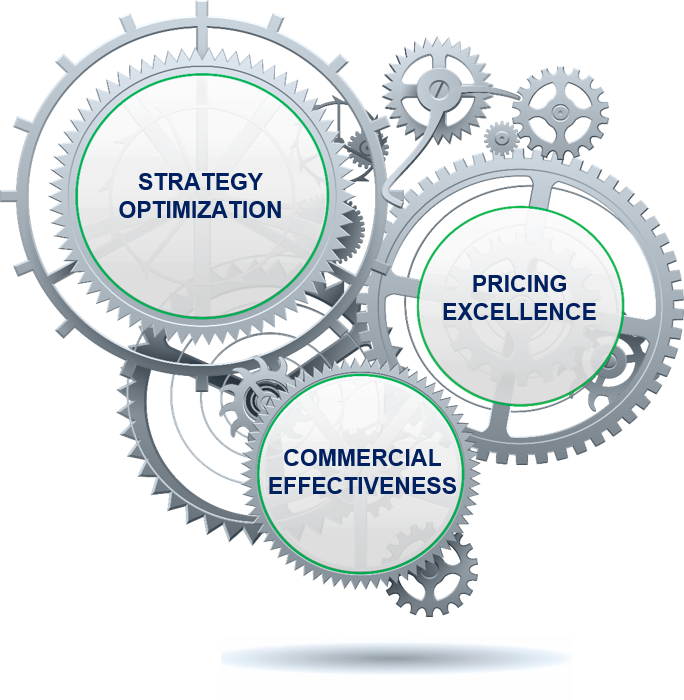
At Stratence Partners, our approach integrates Strategy Optimization, Pricing Excellence, and Commercial Effectiveness with proprietary capabilities in Data Management, Data Science, and Integrated Commercial Systems.
Our SPIE+AI™ framework connects three executive-facing capabilities: trusted Data Management, actionable Data Science, and disciplined Commercial Execution. The objective is to support a reliable view of customer and product economics, evaluate realistic commercial scenarios, and improve the decisions made in the field.
AI can accelerate data mapping, scenario evaluation, and decision support. But technology accelerates a business-designed system; it does not define it.
Implementation is where margin protection becomes sustainable
A pricing diagnostic can reveal the opportunity. A customer profitability model can quantify the gaps. A commercial roadmap can define the target state.
None of them, by itself, changes the next negotiation or the next contract renewal.
Sustainable performance requires governance, aligned incentives, defined decision rights, usable tools, and teams capable of applying the new commercial logic independently.
This is why Stratence approaches Commercial Transformation as an end-to-end journey: from diagnosis and strategic design through implementation, scaling, and capability transfer.
The goal is not permanent reliance on consultants. It is permanent improvement in the organization's commercial decision-making.
Five questions chemical industry executives should be asking
Can we distinguish genuine margin improvement from higher selling prices and changes in input costs?
Do we understand profitability by customer, product, contract, and channel after relevant cost-to-serve factors?
Are our pricing rules differentiated for commodities, specialties, and strategic accounts?
Can teams evaluate price-volume-mix scenarios before approving a commercial decision?
Are strategy, finance, pricing, operations, and sales working with consistent economics and clear decision rights?
If these questions produce different answers across functions, the opportunity is larger than a pricing improvement initiative.
It is an opportunity to transform the commercial operating model.
The competitive advantage is the ability to capture value
Chemical companies cannot control every movement in energy markets, global supply, industrial demand, or feedstock costs.
They can control how clearly they understand the economics of their business, how consistently they price and contract, and how effectively they translate strategic choices into commercial execution.
In an industry where margin can be affected by decisions made across many functions, better integration is not an administrative improvement. It is a source of competitive advantage.
At Stratence Partners, we help leadership teams address structural commercial weaknesses and embed the capabilities needed to capture, protect, and sustainably improve profitable growth.
The question is not simply whether prices are rising. It is whether the organization is capturing more of the value it creates.
Discuss your chemical commercial performance
If your organization is reviewing price-cost spreads, customer profitability, pricing governance, portfolio economics, or commercial execution, we welcome a focused executive discussion.
Fernando VentureiraCEO | Stratence Partners fventureira@stratence.partners www.stratence.partners
Stratence Partners Commercial Transformation, AI Powered A Collaborating Firm of Andersen Consulting


Comments