
Pharmaceutical Profitability Is Not Just a Pricing Challenge

Why sustainable pharmaceutical performance depends on connecting portfolio strategy, gross-to-net economics, market access, and commercial execution.
A pharmaceutical company can have a strong product portfolio.
It can achieve successful launches.
It can expand market access, increase prescription volumes, and report solid revenue growth.
And still fail to capture the full economic value of its commercial activities.
This is one of the defining challenges in today's pharmaceutical industry.
The underlying problem is rarely isolated to pricing, sales, market access, or finance.
It lies in the connections between them.
The real opportunity is not simply to optimize individual commercial functions. It is to transform the entire commercial system.
Growth does not necessarily mean value creation
Pharmaceutical companies operate within one of the world's most demanding commercial environments.
Innovation requires substantial investment. Product lifecycles are exposed to patent expirations, competition, changing treatment standards, regulatory requirements, and evolving reimbursement conditions.
Meanwhile, commercial models must accommodate complex relationships with healthcare professionals, payers, providers, distributors, and other market participants.
These realities create an important distinction:
Generating revenue is not the same as capturing profitable growth.
A product may gain market share while its net realized revenue deteriorates.
A new market access agreement may improve coverage while introducing economic concessions that materially affect profitability.
A successful launch may exceed volume expectations while delivering less value than originally projected.
And commercial teams may achieve their individual objectives without maximizing performance across the portfolio.
The challenge is not necessarily poor execution within each function.
It is the absence of an integrated economic framework connecting their decisions.
Gross-to-net visibility is a strategic capability
In pharmaceuticals, the difference between list prices and net realized revenue can be substantial.
Depending on the market and commercial model, this difference may involve rebates, discounts, chargebacks, distribution fees, contractual provisions, and other financial adjustments.
The resulting gross-to-net waterfall determines how much revenue the organization ultimately retains.
Yet the real challenge goes beyond calculating the waterfall.
Executives need to understand:
Which products, customers, contracts, and channels generate sustainable economic value.
Where rebates and discounts reflect strategic choices—and where they represent avoidable value erosion.
How market access decisions affect portfolio profitability.
Whether commercial incentives reinforce the right behaviors.
How changes in pricing, volume, product mix, and competitive dynamics affect future performance.
Gross-to-net should not be treated exclusively as a financial reporting exercise. It should become a core instrument of commercial decision-making.
The complexity is measurable. Model N's 2026 State of Revenue Report, based on a survey of 429 US pharmaceutical and medical technology executives, found that 99% of respondents considered gross-to-net management increasingly complex. That is an industry survey, not a Stratence performance claim.
The implication extends beyond the United States, although specific contracting, reimbursement, and pricing mechanisms vary substantially across markets.
Without reliable economic transparency, organizations risk making commercially attractive decisions whose profitability is not fully understood.
Market access, pricing, and commercial execution cannot operate independently
Consider a pharmaceutical manufacturer preparing to expand a strategic product across several markets.
The portfolio strategy defines the product's competitive positioning and expected contribution.
Pricing teams establish economic objectives and potential price corridors.
Market access teams evaluate reimbursement pathways and negotiate access conditions.
Finance assesses revenue, profitability, and financial exposure.
Commercial teams execute the strategy within the relevant regulatory and compliance framework.
Every function may perform competently.
But who ensures that all these decisions optimize the same economic outcome?
If pricing decisions are disconnected from reimbursement implications, expected value may not materialize.
If market access agreements are evaluated without sufficient portfolio-level economic visibility, volume growth may obscure profitability trade-offs.
If commercial execution is measured through disconnected performance indicators, teams may optimize activities rather than results.
This is where fragmented commercial structures begin to destroy value.
The solution is not another isolated optimization initiative.
It is an operating model in which Strategy, Pricing, Market Access, Finance, and Commercial Execution work within a coherent decision-making framework.
Portfolio strategy must connect with transaction-level economics
Pharmaceutical portfolio management requires decisions that extend across products, therapeutic areas, geographies, and lifecycle stages.
Some products are entering launch.
Others are approaching maturity or facing new competition.
Some require market access investments.
Others depend on channel optimization, contracting discipline, or more effective resource allocation.
The economic relationships between these decisions are not always visible through conventional reporting.
A strong portfolio strategy must be supported by an equally strong understanding of realized commercial economics.
That requires moving beyond aggregated revenue and margin indicators.
Organizations need the ability to connect strategic scenarios with reliable product-, market-, contract-, and transaction-level information.
They must evaluate not only what a particular decision could generate in additional sales, but also what it means for net revenue, profitability, market positioning, and commercial sustainability.
In other words:
The strategic question is not simply where the company can grow. It is where, how, and under which conditions growth creates the greatest sustainable value.
Data science and AI must improve commercial decisions
Pharmaceutical organizations already generate substantial volumes of commercial, financial, and market information.
The challenge is making that information sufficiently reliable, connected, and actionable.
Data frequently resides across ERP, CRM, pricing, contracting, finance, market access, and business intelligence environments.
Individual functions may have sophisticated reporting capabilities while executives still lack a consistent economic view.
This is precisely where Data Management, Data Science, and Integrated Commercial Systems become essential.
Reliable data integration creates transparency.
Advanced analytics identifies patterns, inconsistencies, and commercial opportunities.
Scenario modeling helps executives evaluate strategic alternatives.
AI can accelerate analysis, support decision-making, and strengthen commercial execution.
But none of these technologies delivers lasting value in isolation.
AI does not replace commercial strategy. It must reinforce the quality, speed, and consistency of strategic and operational decisions.
Technology becomes valuable when it helps the organization answer better questions, make better decisions, and execute them with greater discipline.
From fragmented initiatives to integrated Commercial Transformation
At Stratence Partners, our approach begins with a fundamental principle:
Commercial performance should be managed as one interconnected system—not as a collection of independent functional initiatives.
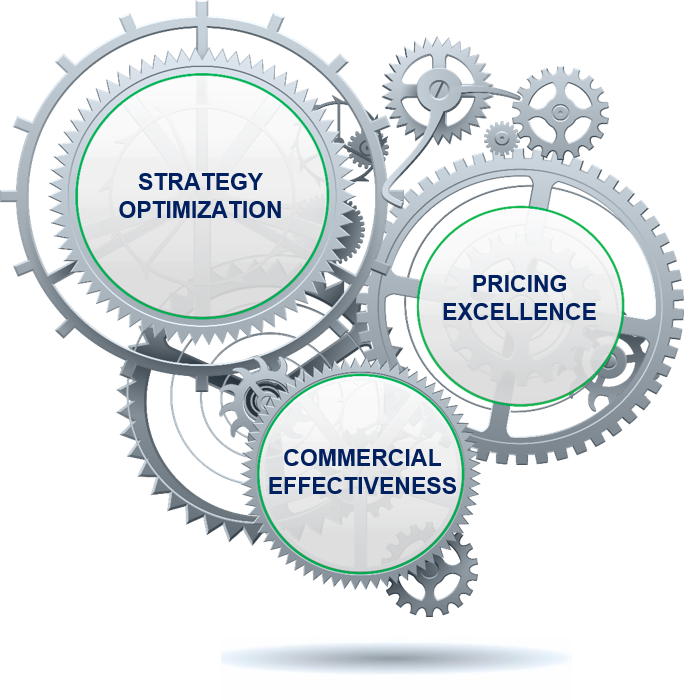
Our work integrates Strategy Optimization, Pricing Excellence, and Commercial Effectiveness, supported by proprietary capabilities in Data Management, Data Science, and Integrated Commercial Systems.
Within pharmaceuticals, this means connecting commercial priorities across the full value chain.
1. Strategy and portfolio optimization.
Strengthening segmentation, value propositions, portfolio economics, and strategic decisions across products and markets.
2. Pricing and contracting excellence.
Improving gross-to-net transparency, pricing governance, contracting discipline, and the ability to quantify economic trade-offs.
3. Commercial and market access effectiveness.
Aligning market access economics, cross-functional decision-making, commercial processes, performance indicators, and execution priorities.
4. Data Management and Data Science.
Connecting fragmented information and translating economic complexity into actionable strategic and commercial intelligence.
5. AI Powered commercial systems.
Using the Stratence Partners Integrated Ecosystem, SPIE+AI™, to reinforce economic transparency, decision quality, and disciplined commercial execution.
These capabilities are supported by an end-to-end methodology that moves from diagnostic and design into implementation, capability building, and scaling.
The objective is not another set of recommendations.
It is to embed better commercial decision-making into the organization.
The executive question that matters
For pharmaceutical leadership teams, the relevant question is not whether the organization has a pricing strategy.
Most do.
Nor is it whether the company has invested in analytics, technology, market access capabilities, or commercial excellence.
Many have.
The more important question is:
Can the organization demonstrate how its strategic, pricing, market access, and commercial decisions work together to maximize sustainable economic performance?
Can it identify the root causes of margin erosion?
Can it connect portfolio ambitions with actual net revenue?
Can it evaluate commercial scenarios across functions?
Can it translate decisions into disciplined execution?
And can it sustain those capabilities independently?
These questions distinguish isolated improvements from genuine Commercial Transformation.
The next competitive advantage in pharmaceuticals
Pharmaceutical competitiveness will continue to depend on innovation, clinical value, market access, and successful commercialization.
But there is another dimension that deserves equal executive attention.
The ability to capture, protect, and optimize the economic value created by the commercial organization.
That requires transparency.
It requires integrated decision-making.
It requires pricing and contracting discipline.
It requires advanced data capabilities.
And above all, it requires the organizational ability to connect strategy with execution.
At Stratence Partners, we work with senior leadership teams to identify structural commercial weaknesses, improve the quality of strategic decisions, and implement sustainable commercial capabilities.
Because in pharmaceuticals, the greatest untapped opportunity may not be another isolated initiative.
It may be the value already being lost between functions, decisions, and execution.
Let's discuss your pharmaceutical commercial performance
If your organization is facing challenges involving portfolio profitability, gross-to-net visibility, pricing governance, market access economics, or commercial execution, we welcome an executive discussion.
Fernando Ventureira
CEO | Stratence Partners
Stratence Partners
Commercial Transformation, AI Powered
A Collaborating Firm of Andersen Consulting
Industry context references: IQVIA, Global Medicine Use Trends 2026; Model N, State of Revenue Report 2026. Survey findings are not Stratence client results.


Comments