
Chemical Companies Don't Need More Data. They Need Commercial Decision Intelligence.

Why disconnected commercial data prevents faster, more profitable executive decisions—and how Commercial Transformation creates a Single Point of Truth for strategy, pricing, and execution.
For many years, chemical companies have invested heavily in digitalization. ERP platforms have evolved, CRM systems have matured, business intelligence capabilities have expanded, and advanced analytics have become increasingly available.
Yet one fundamental question remains.
Why are commercial decisions not becoming significantly better?
Executive teams now receive more reports, dashboards, forecasts, KPIs, and performance indicators than ever before. Commercial organizations collect enormous volumes of information covering customers, products, contracts, rebates, competitors, manufacturing costs, and market dynamics.
Paradoxically, this abundance of information often creates greater uncertainty rather than greater confidence.
The challenge is no longer data availability.
The challenge is transforming fragmented information into trusted commercial decision intelligence.
Data Is Growing. Commercial Clarity Is Not.
Most chemical organizations already possess the information required to make excellent commercial decisions.
The difficulty lies elsewhere.
Commercial data is typically distributed across multiple systems, business units, geographies, product lines, and functional teams. Pricing owns one version of reality. Sales works with another. Finance validates different numbers. Marketing builds separate assumptions. Supply chain operates using different priorities.
Each function performs well individually.
Collectively, however, executive decisions become slower because every strategic discussion begins with the same question:
"Which numbers should we trust?"
The consequence is subtle but significant.
Instead of discussing commercial opportunities, leadership teams spend valuable time reconciling data.
Commercial Complexity Is Becoming an Executive Challenge
The chemical industry has become considerably more sophisticated over the last decade.
Organizations simultaneously manage:
Multi-country operations
Complex product portfolios
Contract-specific pricing structures
Dynamic raw material costs
Long-term supply agreements
Sustainability commitments
Distribution networks
Regulatory compliance
Customer-specific service models
Every additional commercial variable increases complexity exponentially.
Without an integrated commercial operating model, complexity eventually becomes a hidden operational cost rather than a competitive advantage.
The issue is not whether companies possess enough expertise.
The issue is whether that expertise can be transformed into coordinated executive decisions.
Decision Intelligence Requires More Than Analytics
Many organizations respond by investing in additional reporting tools.
Others deploy AI initiatives expecting immediate improvements.
Neither approach solves the structural problem.
Analytics explain what happened.
Artificial Intelligence accelerates processing.
Neither automatically creates commercial alignment.
Executive decision intelligence requires something different:
A commercial framework capable of connecting strategy, pricing, commercial execution, governance, data management, and systems into one coherent operating model.
Only then can leadership teams move from reacting to commercial events toward systematically shaping commercial performance.
Building a Commercial Single Point of Truth
Organizations that consistently outperform their markets rarely make decisions faster simply because they own better technology.
They make better decisions because everyone works from the same commercial reality.
This is where the concept of a Single Point of Truth (SPOT™) becomes strategically important.
Rather than creating additional reports, SPOT™ integrates commercial information into one auditable environment that connects customers, products, pricing, contracts, profitability, and execution.
Instead of debating data quality, executive teams can focus on higher-value discussions:
Where is pricing power increasing?
Which customers create sustainable profitability?
Which commercial policies generate long-term value?
How should resources be allocated?
Which strategic scenarios deserve investment?
Decision-making becomes substantially faster because confidence replaces uncertainty.
Commercial Transformation is frequently associated with organizational redesign or pricing optimization.
In reality, its broader purpose is considerably more strategic.
It creates an operating model where commercial decisions become consistent, transparent,
measurable, and scalable.
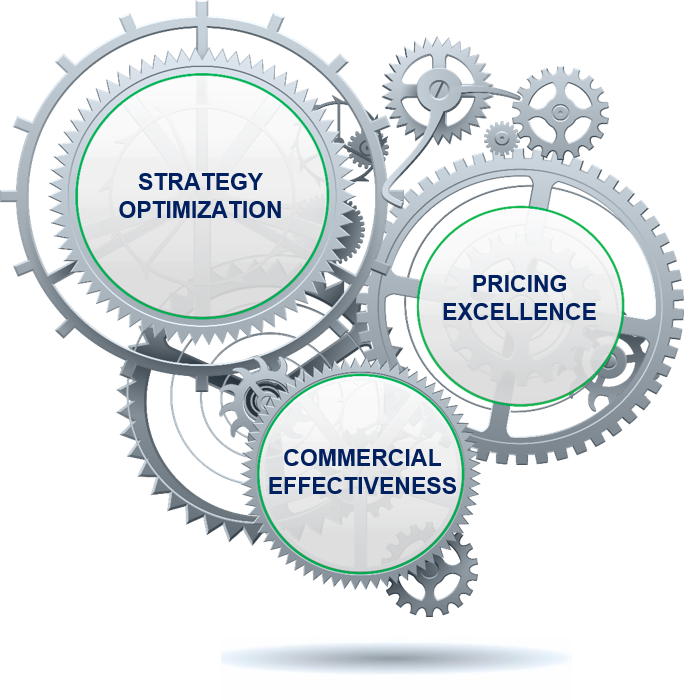
At Stratence Partners, Commercial Transformation begins by aligning four executive dimensions:
Commercial Strategy
Clarifying where value should be created, how markets evolve, and how commercial priorities align with business objectives.
Pricing Excellence and Commercial Effectiveness
Embedding governance, pricing discipline, negotiation frameworks, and execution consistency across the organization.
Data Management and Integrated Commercial Systems
Connecting information across functions into a trusted commercial ecosystem capable of supporting executive decisions.
AI-Powered Capabilities
Applying pragmatic AI to accelerate data integration, scenario simulations, commercial insights, and decision support—always serving business objectives rather than replacing them. This reflects Stratence's positioning, where AI supports Commercial Transformation rather than defining it.
Together, these dimensions transform information into commercial decision intelligence.
Executive Case Example
A multinational specialty chemicals manufacturer had invested significantly in digital platforms over several years.
Commercial dashboards were abundant.
Executive confidence was not.
Regional teams produced different profitability analyses. Pricing recommendations varied between countries. Sales negotiations relied on inconsistent commercial assumptions. Finance required extensive reconciliation before major decisions could be approved.
The transformation did not begin by introducing another analytical platform.
Instead, the organization established a unified commercial architecture based on a Single Point of Truth, integrating pricing, commercial policies, customer profitability, contracts, and commercial governance into one executive framework.
Within months, executive committees reported:
Faster strategic decision cycles
Greater confidence in commercial forecasts
Higher pricing consistency across regions
Stronger alignment between commercial, finance, and sales leadership
Improved governance supporting long-term profitable growth
The most valuable outcome was not another dashboard.
It was a common commercial language shared across the organization.
Conclusion
The chemical industry will continue becoming more complex.
Markets will evolve faster.
Commercial models will become increasingly sophisticated.
Artificial Intelligence will accelerate information processing.
However, competitive advantage will not belong to organizations with the largest quantity of commercial data.
It will belong to those capable of transforming information into disciplined, trusted, and economically sound executive decisions.
Because companies do not compete on data.
They compete on the quality of the commercial decisions that data enables.
The real question is no longer whether your organization has enough commercial information.
It is whether your leadership team trusts the decisions that information is driving.


Comments