
From Strategy to Sustainable Competitive Edge

In today’s margin‑pressured and volatile environment, many organizations believe they have a pricing challenge.
In reality, most have a structural Commercial Transformation challenge.
Strategy is defined. Pricing tools exist. Sales teams are active. AI initiatives are being piloted.
Yet performance remains inconsistent.
The root cause is rarely the absence of pricing techniques. It is the lack of structural integration between strategy, pricing economics and market execution.
Competitive advantage does not emerge from optimizing isolated components. It emerges from aligning the entire commercial framework.
1. An Integrated Decision Framework
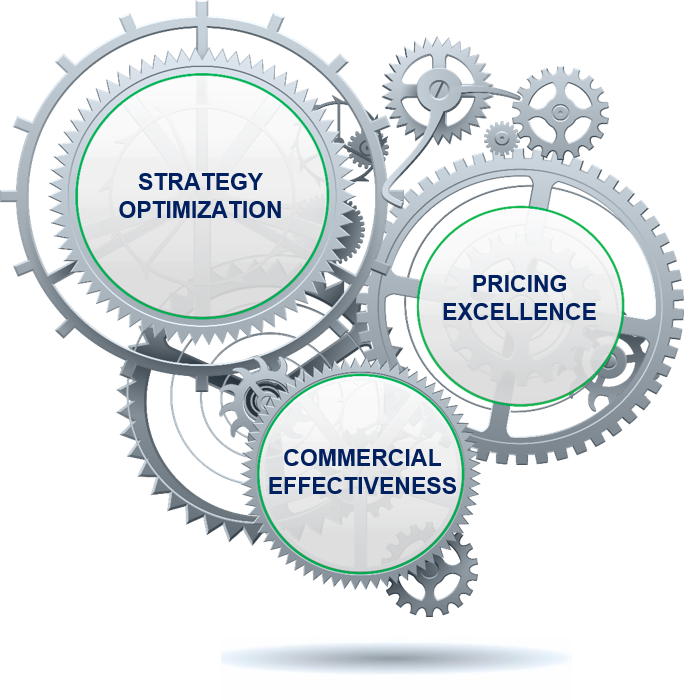
Sustainable competitive edge requires that strategy, pricing economics and commercial execution operate as one coherent system.
Strategic ambition must be economically grounded.Pricing decisions must reflect real market dynamics and margin governance.Sales execution must follow clear corridors, incentives and accountability.
When these elements operate in silos, organizations experience margin leakage, uncontrolled discounting, fragmented data and slow decision cycles.
Commercial Transformation aligns how a company decides, how it prices and how it executes.
Pricing is therefore not a standalone discipline. It is a structural lever within a broader Commercial Transformation architecture.
2. A Proven Transformation Sequence
Transformation does not start with large‑scale rollout. It starts with transparency.
The disciplined sequence is clear:
Establish gross‑to‑net transparency and true profitability visibility.
Prioritize high‑impact levers and measurable quick wins.
Embed governance mechanisms and decision ownership.
Scale capabilities across markets and business units.
This approach ensures that Commercial Transformation becomes measurable, self‑funded and scalable — not theoretical.
3. Governed Best Practices at Scale
Best practices only create value when they are embedded into operating rules.
This requires:
Clear pricing corridors and negotiation authority.
Integrated systems (CRM, CPQ, BI) supporting disciplined execution.
AI‑Powered data management and data science capabilities embedded into workflows.
Defined governance structures across Strategy, Pricing and Commercial functions.
Commercial Transformation integrates these elements into one auditable and scalable framework.
4. Sustained Performance by Design
Short‑term uplift is not the objective.
Structural autonomy is.
Sustainable competitive edge is achieved when:
ROI is measurable and tracked.
Capabilities are transferred.
Governance is institutionalized.
Cross‑functional alignment becomes structural.
Stratence Partners does not optimize isolated parts of Pricing:
We redesign the full Commercial Transformation framework... permanently.
If you are planning to attend the 9th Pricing & Revenue Management Summit in Berlin, we invite you to register directly via Luxatia’s official event page and secure your participation.
If you will be there, feel free to reach out to Fernando Ventureira -FVentureira@Stratence.Partners in advance to arrange a meeting and exchange perspectives in person. A direct message -in LinkedIn- or email is enough to coordinate time during the event.
We look forward to engaging with executives who are ready to move beyond isolated pricing initiatives and toward true Commercial Transformation.


Comments