
The Installed Base: Industrial Manufacturing's Overlooked Source of Profitable Growth

An industrial manufacturer can know exactly how many machines it sold last year.
It can track orders, backlog, production efficiency, and new equipment revenue with considerable precision.
Yet it may still struggle to answer a deceptively simple question:
How much profitable commercial value are we capturing from the equipment already operating at our customers' sites?
For manufacturers of industrial machinery, automation systems, production equipment, and other long-life assets, this is not a secondary question. The installed base can support years of spare-parts demand, maintenance, upgrades, modernization, training, and performance services.
But that potential does not automatically become revenue. And revenue does not automatically become profit.
The opportunity is to manage the installed base as an integrated commercial system, not merely as a historical record of equipment sold.
The business does not end when the equipment is delivered
The original equipment sale is a milestone. It is not necessarily the end of the economic relationship.
Once a machine is installed, customers need to protect uptime, control operating costs, maintain safety and reliability, and extend asset productivity. Those priorities create opportunities for manufacturers to provide continuing value through parts, technical support, preventive maintenance, retrofits, and lifecycle services.
Industry research reinforces the importance of this market. BCG's 2025 industrial aftermarket benchmark identifies service penetration, spare-parts capture, maintenance contract attachment, and renewals as important differences between leading performers and the rest. Deloitte's 2026 Manufacturing Industry Outlook highlights the attractive economics and greater predictability that aftermarket services can provide relative to equipment sales.
The strategic implication is not that every manufacturer should maximize service revenue at any cost.
It is that equipment strategy, aftermarket offerings, pricing, customer economics, and execution should be managed together.
The installed base is often visible technically, but fragmented commercially
An engineering or service team may know a machine's serial number and maintenance history.
Sales may know the customer relationship.
Finance may see parts revenue and service invoices.
Dealers or distributors may control much of the end-customer interaction.
Operations may know the actual cost of a technician's visit, a replacement part, or an urgent repair.
But can leadership connect these perspectives into a reliable commercial view?
A useful installed-base model links, where available and appropriately governed, equipment type, age, geography, customer, channel, warranty status, maintenance coverage, utilization patterns, parts consumption, and realized economics.
Without that connection, management may be unable to distinguish between customers with strong lifetime value and relationships where apparently attractive service revenue is consumed by fulfillment costs and commercial concessions.
You cannot optimize the economics of an installed base that you cannot see consistently.
Not all aftermarket revenue creates the same value
Spare parts, maintenance contracts, emergency interventions, upgrades, and remote support have different cost structures, risk exposures, and sources of customer value.
A critical component that prevents costly downtime is not economically equivalent to a widely available consumable.
A predictable preventive-maintenance agreement is not the same as an open-ended service contract with demanding response guarantees.
A product sold through an independent dealer does not have the same channel economics as one managed directly by the manufacturer.
And a service agreement priced attractively at signature may become unprofitable if actual failure rates, site access, travel time, labor intensity, or parts consumption diverge from assumptions.
This is why aftermarket Pricing Excellence must move beyond a generic list-price increase.
It requires value-based segmentation, disciplined discounting, transparent cost-to-serve, appropriate service-level pricing, and clear commercial authority.
It also requires honoring customer expectations: long-term profitability depends on reliability, fair value, predictable service quality, and trust—not merely on a supplier's ability to charge more for a replacement part.
Contract profitability is decided after the signature
Service agreements often look commercially attractive when evaluated on expected revenue, attachment rates, and renewal potential.
The real economics emerge during delivery.
Consider a multi-year maintenance contract supporting industrial equipment across several customer sites.
The commercial proposal may assume a certain number of interventions, parts usage, technician hours, and response times. But actual utilization, logistics, warranty exposure, and service-level commitments determine whether the promised margin materializes.
Leadership therefore needs a consistent bridge between contracted economics and realized economics.
That means connecting bid assumptions with operational data, invoicing, credits, spare-parts consumption, field service costs, and renewal decisions.
Without this feedback loop, the business may continue renewing contracts whose apparent growth masks deteriorating contribution.
A profitable services business is built through disciplined contract design and equally disciplined execution.
The channel relationship is part of the commercial model
Many equipment manufacturers serve the installed base through distributors, dealers, integrators, or service partners.
These channels can be essential to geographic reach, local responsiveness, and customer access.
They also introduce complex questions about spare-parts capture, pricing consistency, customer ownership, service standards, revenue sharing, and access to equipment data.
Simply attempting to bypass the channel is rarely an adequate strategy.
A better approach defines which capabilities belong with the manufacturer, which should sit with partners, and how the economics and incentives encourage both to deliver customer value.
Channel strategy, pricing governance, and service execution must reinforce each other.
Data and AI should strengthen commercial decisions, not create another silo
Connected equipment and increasingly sophisticated service systems make richer information available to industrial manufacturers.
Data can help identify which assets are nearing a maintenance event, where spare-parts demand may arise, which contracts require intervention, and which customer segments could benefit from upgrades.
Advanced analytics can support demand scenarios, service economics, and price-volume trade-offs.
AI Powered capabilities can accelerate information reconciliation, surface exceptions, assist service planning, and help teams act with greater speed and precision—where the underlying data and controls are sufficiently reliable.
But a prediction is not a commercial decision.
Management still needs to define accountability, customer value, economic objectives, service promises, and the rules governing execution.
Technology becomes a competitive capability when it is integrated into the commercial operating model.
What an integrated Commercial Transformation changes
At Stratence Partners, we approach these challenges through an end-to-end Commercial Transformation framework, combining senior advisory expertise with implementation and capability transfer.
For industrial manufacturers, that means connecting five dimensions:
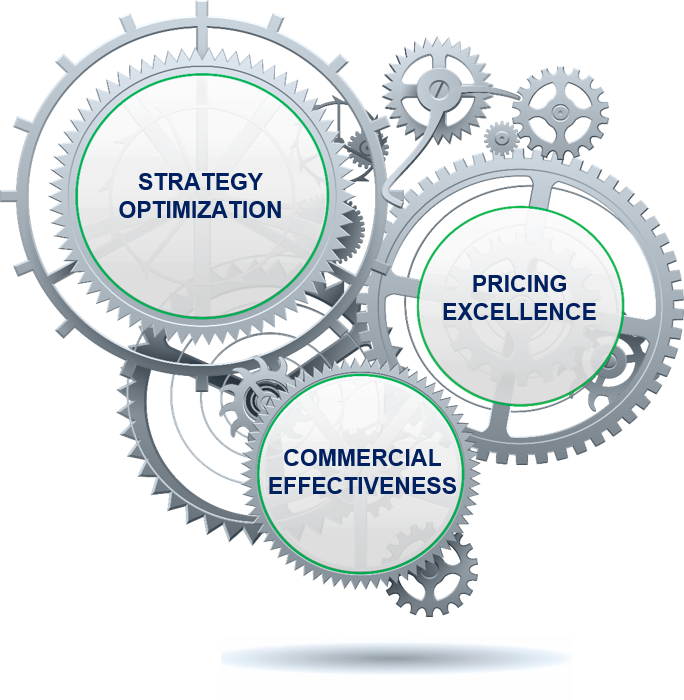
Strategy Optimization. Segment the installed base, prioritize the most relevant customer and equipment opportunities, define channel roles, and align aftermarket propositions with the manufacturer's competitive position.
Pricing Excellence. Strengthen spare-parts pricing, service-level economics, discount governance, contract terms, and the discipline needed to protect value throughout the customer lifecycle.
Commercial Effectiveness. Improve service attachment, account development, renewal management, cross-functional decision rights, and the execution of commercial priorities in the field.
Data Management, Data Science, and Integrated Commercial Systems. Build consistent economic transparency across equipment, customers, channels, parts, services, contracts, and performance indicators.
AI Powered enablement. Use pragmatic analytics and automation to accelerate decisions within an accountable commercial framework—not as a substitute for strategy or implementation.
Our SPIE+AI™ ecosystem is designed to connect strategic, pricing, and commercial decision-making through integrated data and practical execution support.
The objective is not to build another dashboard.
It is to embed a commercial operating model that improves decisions, captures measurable value, and leaves the organization equipped to sustain the change itself.
Five questions industrial leadership teams should be able to answer
Installed-base visibility. What proportion of our active equipment population can we reliably connect to a customer, channel, service status, and economic opportunity?
Aftermarket capture. Where are we losing parts, service contracts, renewals, or upgrade opportunities—and why?
Customer and contract profitability. Which customer relationships and service agreements create sustainable contribution after discounts, labor, logistics, and other relevant delivery costs?
Commercial alignment. Do Equipment Sales, Service, Finance, Pricing, and channel partners operate with consistent incentives, decision rights, and performance measures?
Execution and autonomy. Can our teams use reliable data to make better decisions repeatedly, without creating dependence on a transformation program or external advisers?
If these questions produce five different answers across five functions, the issue is not a lack of commercial activity.
It is the absence of an integrated commercial framework.
The next source of industrial growth may already be in the field
Industrial manufacturing competitiveness will continue to depend on innovation, product quality, manufacturing excellence, and operational efficiency.
But manufacturers of long-life equipment have another source of potential advantage: the economic relationship with the assets and customers they already serve.
Realizing that potential requires more than adding services to an equipment portfolio.
It requires connecting strategy, pricing, customer value, contract economics, channel relationships, data, and commercial execution.
The installed base becomes a strategic asset when the organization can see its economics, serve customers better, and capture value consistently over time.
At Stratence Partners, we help executive teams make that connection through Commercial Transformation, AI Powered, from diagnostic and design through implementation and capability transfer.
For an executive discussion about industrial aftermarket profitability and Commercial Transformation:
Fernando Ventureira | CEO, Stratence Partners
Stratence Partners — Commercial Transformation, AI Powered
A Collaborating Firm of Andersen Consulting


Comments