
Industrial Manufacturing: Turning Commercial Complexity into Measurable EBIT Impact

Industrial Manufacturing has historically been a benchmark for operational excellence.
Lean processes, optimized supply chains, and cost efficiency have been the primary levers of competitiveness.
However, as markets become more volatile, customer expectations evolve, and pricing dynamics become more complex, operational excellence alone is no longer sufficient.
The real challenge has shifted.
From operations to commercial performance.
The Structural Challenge Behind EBIT Erosion
Across industrial organizations, a consistent pattern emerges.
Despite strong operational foundations, companies continue to experience:
Margin leakage across pricing waterfalls
Inconsistent pricing practices across regions and business units
Misaligned go-to-market strategies and segmentation models
Limited visibility on true customer and product profitability
Slow decision-making due to fragmented data and disconnected systems
These are not isolated issues.
They are structural.
And they typically result in 4–12% annual EBIT loss.
Why Traditional Approaches Fail
Most organizations attempt to address these challenges through:
Pricing projects
CRM or ERP implementations
Sales effectiveness programs
While valuable, these initiatives are often executed in isolation.
They optimize parts of the system.
But they do not fix the system.
As a result, complexity remains, and performance improvements are not sustainable.
Commercial Transformation as an Operating Model
At Stratence Partners, we approach Industrial Manufacturing through a different lens.
Commercial Transformation is not a project. It is an operating model.
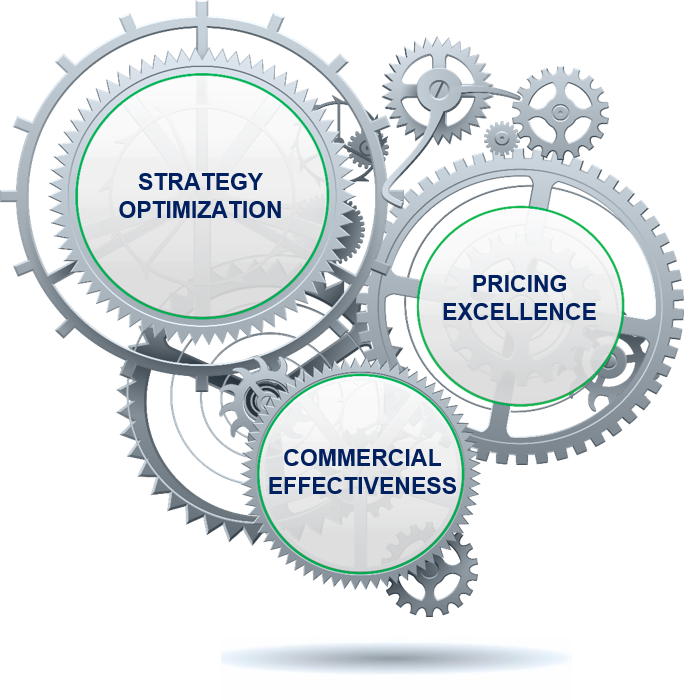
It requires aligning three critical dimensions:
Strategy → How the company defines where and how to compete
Pricing → How value is captured and protected
Execution → How strategy and pricing are implemented in the field
This alignment must be supported by:
Clear governance and decision architecture
Integrated data and systemsConsistent processes and incentives
From Data to Decision: The Role of AI Powered Systems
Industrial companies are not lacking data.
They are lacking structured decision systems.
Stratence addresses this through AI Powered commercial systems, designed to:
Create a Single Point of Truth across customers, products, and transactions
Provide full gross-to-net transparency
Quantify pricing power and market response
Guide sales execution through structured negotiation corridors
The objective is not to generate more data.
It is to enable faster, more confident executive decisions.
From Complexity to Control
When Strategy, Pricing, and Execution operate as one system, organizations achieve:
Measurable EBIT uplift (+3–7% within year one)
Improved pricing discipline and reduced margin leakage
Faster and more reliable decision-making
Stronger alignment across functions and geographies
Most importantly, they build commercial autonomy.
A Self-Funded Transformation Journey
One of the critical elements of successful transformation is sustainability.
Stratence’s approach is designed to be self-funded, with:
Early quick wins generating immediate impact
Progressive capability building across teams
Full transfer of knowledge and tools to the organization
The goal is not dependency.
It is autonomy.
Final Thought
Industrial Manufacturing is entering a new competitive era.
Operational excellence is now a baseline.
The real differentiator is the ability to manage commercial complexity with precision, speed, and discipline.
The question is no longer whether transformation is needed; It is how fast organizations can move from fragmented decisions to an integrated commercial system.


Comments