
Rewiring Commercial Performance in Utilities: From Regulated Stability to AI-Powered Execution Discipline

Why traditional commercial models in Utilities are no longer sufficient to protect margin, control complexity, and sustain performance
Introduction
Utilities organizations have historically operated within relatively stable regulatory and market environments. However, this stability is progressively eroding.
Increasing market liberalization, energy transition pressures, decentralized generation, and volatile cost structures are exposing structural weaknesses in commercial performance.
What used to be manageable through incremental adjustments is now revealing a deeper issue:
Utilities are not failing because of strategy—but because of the gap between strategy, pricing, and execution.
What is structurally failing in the market
Across the Utilities sector, a recurring pattern emerges:
Fragmented pricing logic across products, geographies, and customer segments
Limited transparency on true margin drivers across the gross-to-net waterfall
Disconnected systems (CRM, billing, regulatory frameworks) preventing consistent execution
Decision-making slowed by data fragmentation and lack of integrated intelligence
The consequence is not tactical inefficiency; it is structural commercial erosion.
Companies believe they are managing pricing, but in reality, they are reacting to complexity rather than controlling it.
Impact on business performance
The impact is measurable and persistent:
Margin leakage embedded in tariff structures, discounts, and contract conditions
Inconsistent commercial execution across regions and customer segments
Slow response to market signals (cost changes, demand shifts, regulatory adjustments)
Limited ability to translate strategy into field-level behavior
This leads to a silent but continuous deterioration of EBIT—often within the 4–12% annual erosion range observed across industries.
A structured approach: from complexity to controlled performance
Addressing these challenges requires more than pricing initiatives or digital upgrades.
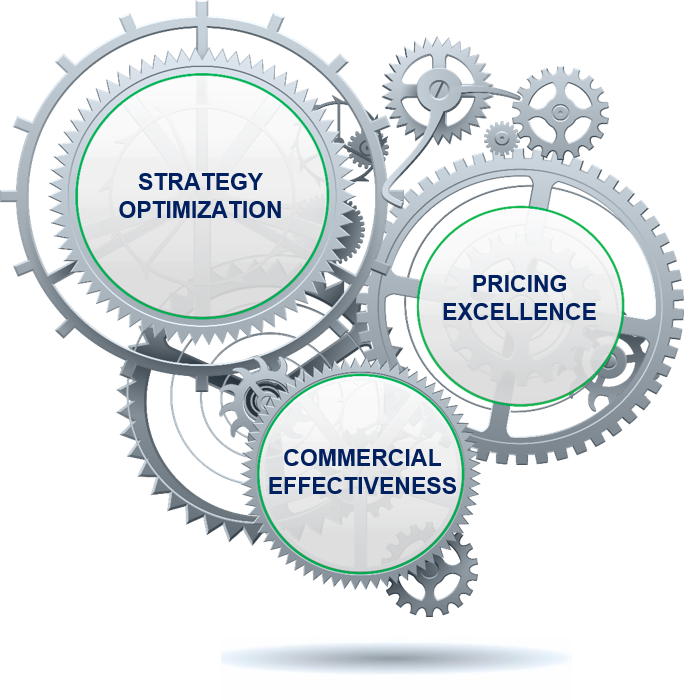
It requires a full Commercial Transformation, structured across three integrated layers:
1. Strategy Optimization
Dynamic segmentation based on behavioral and profitability data
Clear definition of value drivers across customer portfolios
Alignment between regulatory constraints and commercial objectives
2. Pricing Excellence
Full gross-to-net transparency across tariffs, incentives, and contracts
Value-based pricing frameworks adapted to regulated environments
Structured governance for pricing decisions and approvals
3. Commercial Effectiveness
Alignment of roles, incentives, and execution processes
Standardized negotiation and contracting practices
Integration of strategy into daily commercial behavior
All enabled by specific and proprietary solutions for Data Management, Data Science, and Integrated Commercial Systems, AI Powered.
This is not a set of initiatives; it is an operating model transformation.
Case Example (realistic scenario)
A multi-country Utilities company faced declining margins despite stable volumes and regulated pricing frameworks.
Problem
No visibility on true profitability by customer segment
Inconsistent tariff application across regions
Manual contracting and discounting processes
Intervention
Implementation of a Single Point of Truth integrating commercial and financial data
Full redesign of the gross-to-net waterfall
Deployment of structured pricing governance and commercial playbooks
Result
+3.5% net price improvement within 9 months
+10% increase in margin consistency across regions
Significant reduction in execution variability and decision time
Conclusion
Utilities organizations are entering a phase where commercial discipline—not scale—will define performance.
The real challenge is not adapting to complexity, but structuring it into a controlled, auditable, and scalable system.
This is the role of AI-Powered Commercial Transformation:
To connect strategy, pricing, and execution into one coherent system that delivers measurable and sustainable results.
The question is no longer whether transformation is needed—but whether your organization is structurally equipped to execute it.


Comments