
From Operational Complexity to Commercial Transformation: Why Margin Visibility Has Become the New Competitive Advantage in Transport & Logistics

In an industry where operational efficiency has become the norm, sustainable profitability increasingly depends on pricing governance, customer profitability transparency, and disciplined commercial execution.
Transport and logistics organizations have spent decades improving operational efficiency.
Networks have been optimized. Warehouses have become more productive. Transportation planning has become more sophisticated. Digital platforms have improved visibility across the supply chain.
Yet many executive teams continue to face the same challenge.
Revenue grows. Volumes increase. Operations improve.
Profitability remains inconsistent.
The reason is often not operational.
It is commercial.
Many organizations still manage commercial decisions through fragmented processes, disconnected data sources, inconsistent pricing practices, and limited visibility into the true profitability of customers, contracts, routes, products, and services.
As market volatility increases and customer expectations evolve, operational excellence alone is no longer sufficient.
Commercial Transformation is becoming a strategic requirement.
What Is Really Happening
Most transport and logistics organizations have developed significant operational capabilities.
The challenge is that commercial decisions frequently evolve faster than governance frameworks.
Different business units negotiate contracts differently.
Discounts are applied without full visibility of downstream consequences.
Contract renewals often prioritize volume retention rather than profitability optimization.
Customer profitability can vary significantly despite similar revenue levels.
Data exists across ERP, CRM, transport management, warehouse management, and business intelligence platforms, but often remains disconnected from commercial decision-making.
The result is not a lack of information.
It is a lack of decision architecture.
Executives may see revenue performance.
They often struggle to see margin behavior.
Without transparent visibility into gross-to-net economics, commercial complexity gradually erodes profitability.
Business Impact
The consequences are rarely visible through a single KPI.
Instead, they accumulate gradually across the organization.
Common symptoms include:
Margin leakage through uncontrolled pricing practices
Inconsistent contract governance across regions and business units
Limited visibility into customer-level profitability
Slow commercial decision-making
Excessive dependence on manual reporting
Misalignment between strategic objectives and field execution
Difficulty prioritizing profitable growth opportunities
As commercial complexity increases, organizations often find themselves managing symptoms rather than addressing root causes.
Operational performance remains strong.
Commercial performance becomes increasingly difficult to control.
What Needs To Change
The solution is not another reporting layer.
Nor is it simply implementing new technology.
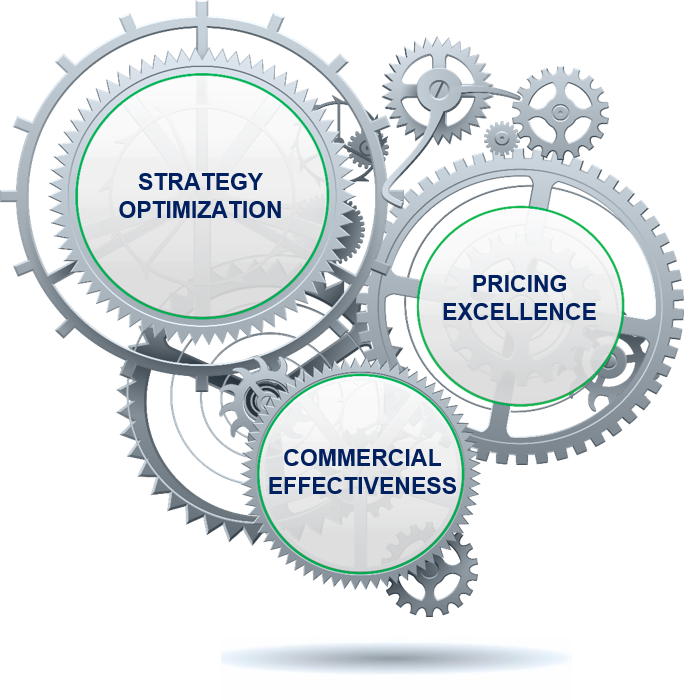
The challenge requires an integrated Commercial Transformation approach.
Organizations need to establish a unified framework connecting:
Strategy Optimization
Pricing Excellence
Commercial Effectiveness
Data Management
Data Science
Integrated Commercial Systems
When these capabilities operate together, executives gain visibility into the economic reality of the business.
✅ Decision rights become clearer.
✅ Pricing governance becomes more disciplined.
✅ Customer profitability becomes measurable.
✅ Commercial execution becomes aligned with strategic objectives.
AI-Powered systems can then accelerate decision-making, automate analysis, and improve transparency.
However, AI only creates value when embedded within a coherent commercial operating model.
Technology alone does not solve governance challenges.
Commercial Transformation does.
Case Example
Situation
A multinational logistics provider operating across multiple countries was experiencing continued revenue growth but declining profitability in key customer segments.
Contract negotiations varied significantly between regions, customer profitability was difficult to assess, and leadership lacked a consistent view of commercial performance.
Intervention
The organization implemented a Commercial Transformation program focused on pricing governance, customer profitability transparency, gross-to-net visibility, and integrated commercial decision-making.
A unified data environment was established to connect strategic, pricing, and operational information while improving governance and accountability across commercial teams.
Measurable Impact
Within twelve months, the organization achieved:
6% improvement in net realized price
11% increase in EBIT contribution
Significant reduction in margin variability across customer segments
Faster commercial decision cycles
Greater alignment between strategy, pricing, and field execution
Most importantly, commercial decisions became measurable, transparent, and repeatable.
Conclusion
Transport and logistics organizations have already achieved remarkable operational progress.
The next frontier is commercial.
The organizations that create sustainable competitive advantage will not necessarily be those moving goods more efficiently.
They will be those making better commercial decisions, faster, with greater transparency, stronger governance, and clearer accountability.


Comments