
Commercial Volatility in Oil & Gas Is No Longer a Market Problem. It Is a Commercial System Problem.

Volatility in Oil & Gas has structurally changed.
What was historically cyclical is now persistent, multi-dimensional, and increasingly unpredictable. Commodity prices, geopolitical tensions, regulatory shifts, energy transition dynamics, and regional imbalances are no longer isolated variables—they interact continuously.
For CEOs and executive teams, the challenge is no longer understanding volatility.
The challenge is whether their commercial model is structurally capable of responding to it.
Across the sector, we consistently observe the same pattern: companies do not lose margin because of market conditions alone.
They lose it because their commercial systems cannot absorb and react with sufficient speed, consistency, and control.
WHAT IS FAILING IN THE MARKET
The core issue is not pricing strategy.
It is execution architecture.
Oil & Gas organizations operate with high contractual complexity: long-term agreements, index-linked pricing, regional variations, logistics components, rebates, and negotiated exceptions.
Individually, these elements are manageable.
Collectively, they create structural opacity.
We typically observe:
Fragmented contract logic across regions and business units
Limited visibility at deal and transaction level
Slow pass-through of market signals into pricing and contracts
Misalignment between strategy, pricing, and field execution
Manual workarounds replacing structured decision systems
The result is not visible as a single issue.
It accumulates silently across thousands of decisions.
IMPACT ON THE BUSINESS
This execution gap translates directly into measurable business impact:
Margin leakage across the gross-to-net waterfall
Inconsistent pricing behavior across markets and customers
Loss of negotiation authority in front of clients
Delayed reactions to market movements
Increasing operational complexity and decision latency
In most cases, this represents 4–12% EBIT erosion annually, driven not by wrong decisions—but by inconsistent execution of the right ones.
STRUCTURED RESPONSE: COMMERCIAL TRANSFORMATION
Addressing this challenge does not require more pricing initiatives.
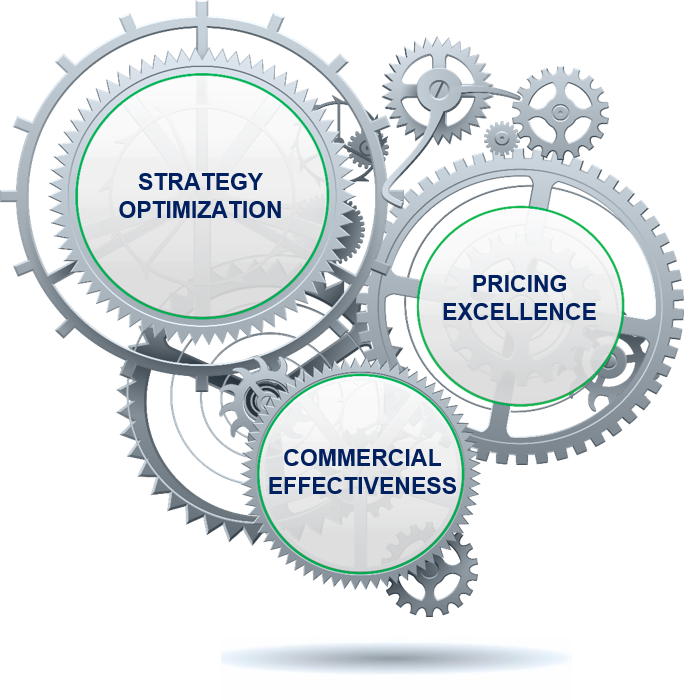
It requires a structural redesign of how strategy, pricing, and commercial execution operate as one system.
This is what we define as Commercial Transformation.
A structured approach typically includes:
Strategy Optimization
Clear definition of value logic, segmentation, and market positioning translated into executable frameworks
Pricing Excellence
Full transparency and control of the gross-to-net waterfall, with consistent pricing governance across contracts and markets
Commercial Effectiveness
Alignment of roles, incentives, negotiation frameworks, and execution processes with strategic intent
Integrated Commercial Systems
Deployment of data management, data science, and execution systems enabling real-time visibility and decision support
This is not about adding tools.
It is about building an auditable, integrated commercial operating model where decisions are consistent, traceable, and scalable.
CASE EXAMPLE
A global Oil & Gas player operating across multiple regions faced persistent margin erosion despite strong market positioning.
Problem:
Lack of visibility on deal-level profitability
Inconsistent contract structures across regions
Delayed pass-through of commodity price changes
Heavy reliance on manual pricing adjustments
Intervention:
Creation of a Single Point of Truth integrating contract, pricing, and transaction data
Standardization of pricing governance and approval logic
Implementation of gross-to-net transparency dashboards
Alignment of negotiation frameworks and incentive structures
Result:
+3.5% net price improvement within 9 months
Full visibility on deal-level economics across regions
Reduction of pricing exceptions >40%
Faster reaction to market signals with measurable impact on margin
CONCLUSION
In Oil & Gas, volatility is no longer the main challenge.
The real question is whether the commercial system is designed to operate under volatility.
Organizations that continue to treat pricing, contracts, and execution as separate domains will continue to lose margin silently.
Those that integrate them into one coherent, governed, and AI Powered commercial system will turn volatility into a structural advantage.
The difference is not strategic intent.
It is execution architecture.
Executive question:


Comments