
Chemical Industry Under Margin Pressure: Why Commercial Transformation Has Become a Structural Imperative

Introduction
Chemical companies are operating in an increasingly complex commercial environment where volatility is no longer episodic but structural.
Feedstock fluctuations, energy cost instability, regulatory pressure, and global supply chain reconfiguration are converging with intensified customer negotiation dynamics.
The result is not only margin pressure. It is a progressive loss of control over how value is priced, negotiated, and captured across markets.
This is not a market problem alone. It is a commercial system challenge.
What is failing in the market
Across the chemical industry, a recurring pattern is emerging:
Pricing logic remains disconnected from real customer value and market behavior
Contracts and rebate structures evolve faster than internal governance
Commercial decisions are fragmented across regions, products, and accounts
Data exists, but not as a unified decision system
In many cases, organizations still operate with partial visibility of their true net price and profitability at deal level.
Without a Single Point of Truth (SPOT), decisions remain opinion-based rather than economically grounded.
Business impact
The consequences are structural and measurable:
Margin leakage across the gross-to-net waterfall
Increasing discount dispersion without strategic rationale
Slow and inconsistent decision-making
Execution gaps between strategy, pricing, and sales
Benchmarking across industries shows that companies systematically lose between 4% and 12% of EBIT due to these structural weaknesses.
In the chemical sector, where margins are highly sensitive to input costs and volume dynamics, this erosion compounds rapidly.
Structured solution approach
Addressing this challenge requires more than pricing initiatives or isolated digital tools.
It requires a full Commercial Transformation approach.
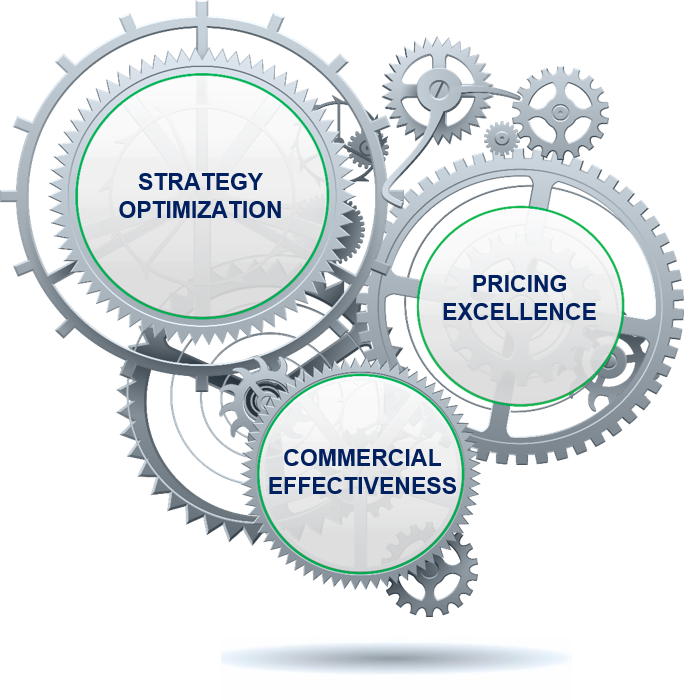
At Stratence Partners, this means aligning three dimensions into one coherent operating model:
Strategy Optimization
Defining where value is created, how markets are segmented, and how pricing power is structurally built.
Pricing Excellence
Establishing end-to-end gross-to-net transparency, disciplined contracting, and value-based pricing frameworks.
Commercial Effectiveness
Embedding execution through governance, incentives, and AI-Powered commercial systems integrated with CRM, CPQ, and BI.
All supported by proprietary solutions for Data Management, Data Science, and Integrated Commercial Systems, always AI-Powered.
The objective is not incremental improvement.
It is to create a unified, auditable, and scalable commercial system that restores control and enables consistent decision-making.
Case Example
A global specialty chemicals company was experiencing margin erosion despite stable volumes.
Problem:
Significant discount dispersion across regions and accounts
Limited visibility on true net price at transaction level
Contracts and rebates not aligned with market dynamics
Intervention:
Implementation of a SPOT-based data architecture integrating pricing, contracts, and sales data
Full gross-to-net waterfall reconstruction
Definition of strategic pricing corridors and governance rules
Deployment of AI-Powered commercial cockpits for sales teams
Result:
+3.5% net price improvement within 9 months
Reduction of discount dispersion by more than 20%
Faster decision cycles across regions
Full alignment between pricing strategy and field execution
Conclusion
In the chemical industry, performance is no longer determined only by production efficiency or market positioning.
It is determined by the ability to translate strategy into disciplined, data-driven commercial execution.
Commercial Transformation is not a project. It is the operating model that connects strategy, pricing, and execution into one system.
The question is no longer whether to transform.
It is whether your commercial system is structured to capture the value you already create.


Comments