
How SPIE+AI™ transforms fragmented pricing, data, and execution into a governed commercial operating system for Utilities leaders

Why Utilities Organizations Need a Commercial Control Architecture — Not Another Dashboard
Introduction
Utilities organizations are operating under increasing structural complexity.
Energy transition, decentralized generation, dynamic tariffs, regulatory pressure, customer volatility, infrastructure modernization, and margin sensitivity are fundamentally changing how commercial performance must be governed.
Yet despite massive investments in digitalization, many Utilities organizations still struggle with:
Slow commercial decision-making
Limited pricing transparency
Inconsistent execution across regions and business units
Margin leakage hidden inside contracts, discounts, incentives, and operational exceptions
Fragmented visibility between finance, commercial, operations, and customer management
The issue is not a lack of systems.
The issue is that most organizations still operate through disconnected commercial structures.
CRM, ERP, billing, forecasting, CPQ, analytics, and reporting layers coexist without functioning as one integrated commercial operating model.
And when complexity increases, fragmentation becomes expensive.
Not theoretically.
Economically.
What is really happening in Utilities commercial operations
Most Utilities organizations already understand the importance of data and digital transformation.
However, many initiatives remain focused on infrastructure modernization, reporting enhancement, or isolated analytics capabilities.
What remains structurally unresolved is the commercial execution layer.
The recurring issues are remarkably consistent across the industry:
Pricing logic disconnected from field execution
Inconsistent governance across regions or business units
Limited visibility on true customer profitability
Slow approval and exception management flows
Margin erosion hidden inside gross-to-net complexity
Excessive dependency on spreadsheets and local interpretation
Difficulty translating strategy into operational execution
Commercial decisions operating without unified governance logic
This creates a structural execution gap.
And execution gaps silently become EBIT erosion.
Stratence benchmarking across more than 800 projects shows that organizations can lose between 4% and 12% of EBIT every year due to structural commercial weaknesses.
The problem is rarely one isolated decision.
It is the accumulation of disconnected decisions operating without an integrated commercial architecture.
Why traditional dashboards are not enough anymore
Most dashboards report performance.
Very few systems govern performance.
This distinction is critical.
Utilities organizations do not simply need more visibility.
They need:
Decision consistency
Pricing governance
Gross-to-net transparency
Execution discipline
Structured commercial autonomy
Cross-functional alignment
Real-time operational intelligence
Governance embedded into execution
This is precisely where many organizations remain structurally exposed.
Because data without governance still creates fragmented execution.
And analytics without operating discipline rarely create sustainable impact.
What SPIE+AI™ really is
SPIE+AI™ is not another reporting platform.
It is not positioned as a standalone AI layer.
And it was never designed as a technology-first initiative.
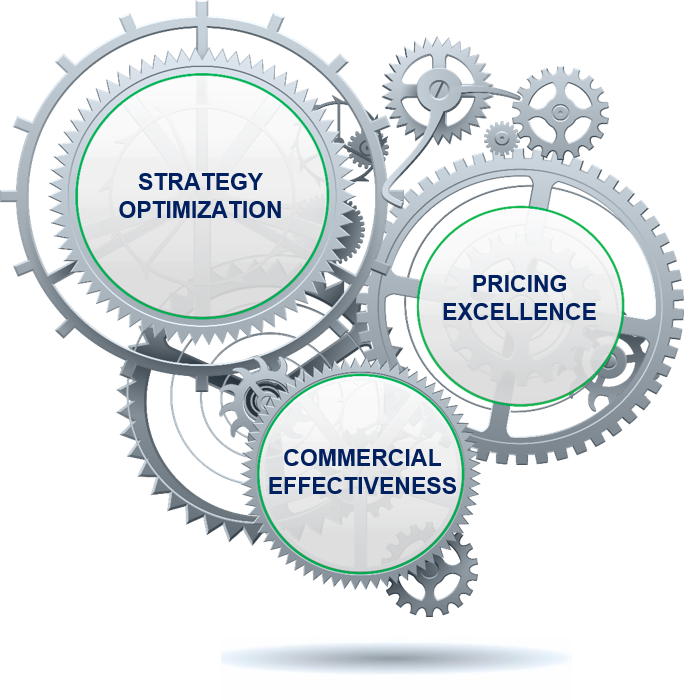
SPIE+AI™ is an AI-Powered Commercial Transformation operating framework designed to connect:
Strategy Optimization
Pricing Excellence
Commercial Effectiveness
Data Management
Data Science
Execution Governance
Into one coherent, auditable commercial ecosystem.
As defined within Stratence Partners’ integrated methodology, SPIE+AI™ is structured around three executive-facing modules:
SPIE+AI™ Data Management — Trusted Transparency
Built around SPOT™ (Single Point of Truth), this layer integrates commercial, pricing, operational, customer, and financial data into one auditable environment.
The objective is not only transparency.
It is decision consistency.
This allows Utilities organizations to move away from fragmented local interpretations toward governed commercial visibility.
SPIE+AI™ Data Science — Gross-to-Net Intelligence
This layer transforms data into commercial economics.
It structures:
Gross-to-net transparency
Pricing corridors
Margin consistency analysis
Customer profitability logic
Scenario simulations
Discounting visibility
Competitive response modeling
The objective is to move from reactive pricing behavior toward governed pricing architecture.
Not theoretical optimization.
Operational execution.
SPIE+AI™ Commercial Excellence — Disciplined Execution
This layer connects strategy directly with field execution.
It structures:
Negotiation authority
Incentive governance
Approval discipline
Deal consistency
Market intelligence feedback loops
Commercial execution rules
The objective is not centralized control for its own sake.
It is scalable commercial autonomy.
Why this matters now for Utilities leaders
Utilities organizations are entering a phase where performance pressure will increasingly come from execution complexity rather than from pure market conditions.
Organizations operating with fragmented commercial structures will progressively struggle to:
Sustain pricing discipline
Govern execution consistently across business units
Protect profitability under volatility
React quickly to market and regulatory changes
Translate AI investments into measurable EBIT impact
Maintain commercial governance at scale
This is precisely why Commercial Transformation must evolve from initiative to operating capability.
Because sustainable performance improvement is not created by isolated projects.
It is created by governed systems.
Case Example
A multi-region Utilities organization was experiencing increasing commercial inconsistency despite stable market demand and significant digital investments.
Situation
Pricing execution varied significantly across business units
Margin leakage visibility was fragmented
Customer profitability analysis lacked consistency
Commercial approvals created operational delays
Different systems produced conflicting commercial views
Intervention
Stratence implemented a phased SPIE+AI™ Commercial Transformation framework integrating:
SPOT™ centralized commercial transparency
Gross-to-net analytics and pricing governance
Standardized negotiation and approval structures
Commercial execution dashboards connected to field operations
Cross-functional governance between commercial, finance, and operations
Impact
Within 12 months:
Commercial decision-making speed improved significantly
Approval cycle times were reduced by more than 40%
Margin consistency improved materially across business units
Gross-to-net visibility increased substantially
Commercial execution became measurably more aligned across regions
Most importantly, the organization moved from fragmented local optimization toward a unified commercial operating model.
Conclusion
Utilities organizations do not need more disconnected dashboards.
They need a commercial control architecture capable of aligning:
Strategy
Pricing
Governance
Incentives
Execution
Market intelligence
Data transparency
Into one coherent operating logic.
This is where SPIE+AI™ creates value.
Not by replacing leadership.
But by strengthening the organization’s ability to execute consistently, transparently, and at scale.
Because ultimately, sustainable performance improvement is not created by isolated decisions.
It is created by governed commercial systems.


Comments