
From Strategy to Execution Discipline: How Leading Companies Build a Sustainable Competitive Edge

INTRODUCTION
Across industries such as pharmaceuticals & life sciences, chemicals, medical devices, energy & utilities and industrial manufacturing, the gap between strategy definition and commercial execution continues to widen.
Most organizations have clear strategic ambitions. Many have invested in pricing tools, analytics, and digital initiatives. Yet, tangible and sustained impact on margin, growth, and execution discipline remains inconsistent.
The issue is not the absence of strategy or technology.
It is the absence of an integrated commercial decision system that connects how organizations decide, price, and execute.
WHAT IS NOT WORKING
The market continues to approach commercial transformation as a sequence of disconnected initiatives:
Strategy is defined at the top, but not translated into operational decision rules
Pricing models evolve, but without full gross-to-net transparency or execution control
AI and analytics are deployed, but remain disconnected from frontline decisions
Sales execution operates with autonomy, but without structured guidance or governance
This fragmentation creates a structural execution gap.
IMPACT ON BUSINESS
The consequence is not marginal inefficiency — it is structural profit erosion.
Organizations experience:
4–12% EBIT loss due to margin leakage and lack of pricing discipline
Inconsistent deal outcomes across markets and customers
Slow and uncertain decision-making due to fragmented data environments
Limited ability to scale best practices across regions and business units
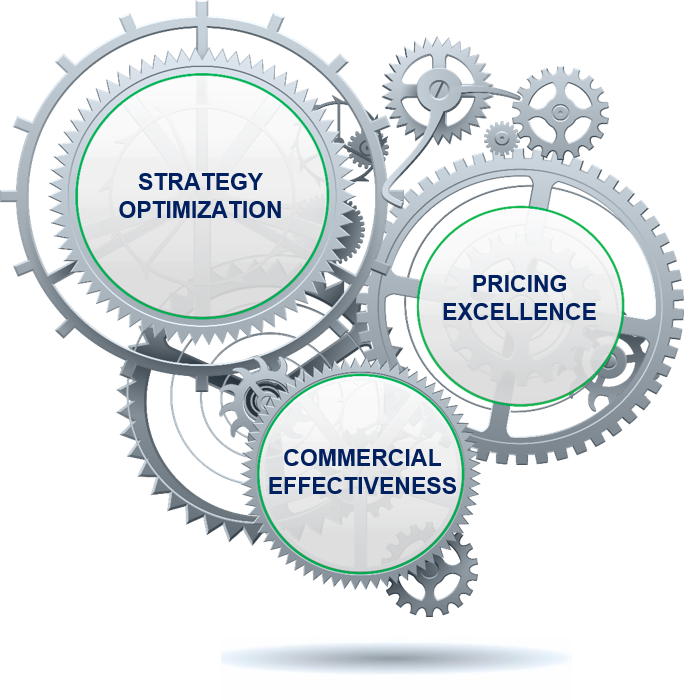
At its core, the issue is systemic: strategy, pricing, and execution are not operating as one.
STRUCTURED SOLUTION APPROACH
Sustainable competitive edge is not achieved through isolated improvements. It requires a structured commercial transformation model built on four pillars:
1. Integrated Decision Framework Strategy, pricing economics, and market execution must operate within a single decision architecture. This ensures that every commercial action reflects both strategic intent and economic reality.
2. Proven Transformation Sequence Transformation must follow a structured path: early transparency (data and gross-to-net), focused implementation (quick wins and priority capabilities), and scalable deployment across the organization.
3. Governed Best Practices at Scale Best practices only create value when embedded into governance. This includes clear roles, approval flows, data ownership, and execution rules supported by integrated systems.
4. Sustained Performance by Design Performance must be engineered through measurable ROI discipline, ownership, adoption, and capability transfer — ensuring autonomy beyond the transformation phase.
This model reflects how leading organizations move from isolated initiatives to a fully integrated commercial operating system.
CASE EXAMPLE
A global industrial organization operating across multiple regions faced inconsistent pricing outcomes and limited visibility on net margins.
Problem:
Fragmented pricing data across regions
Lack of transparency on discounting and rebates
Inconsistent deal approval processes
Intervention:
Implementation of a Single Point of Truth (SPOT) integrating transactional data
Deployment of gross-to-net transparency across all markets
Definition of pricing governance and deal approval corridors
Integration of AI‑supported analytics into commercial decision workflows
Result:
+5% improvement in net price within 9 months
Significant reduction in margin dispersion across regions
Faster and more consistent deal decision-making
Full alignment between pricing strategy and sales execution
CONCLUSION
Sustainable competitive advantage in commercial organizations is not a function of better strategy alone.
It is the result of an integrated system where strategy, pricing, and execution operate with transparency, governance, and discipline.
Commercial Transformation, AI‑Powered, is not about adding tools or initiatives.
It is about redesigning how decisions are made, executed, and scaled.
The organizations that succeed are those that move beyond fragmented improvements and build a unified commercial operating model.
EXECUTIVE QUESTION
Is your organization truly executing its strategy... or managing a collection of disconnected commercial initiatives?

Comments