
From Pricing to Competitive Edge: Why Commercial Transformation Is Now a System, Not a Function

INTRODUCTION
Across pharmaceuticals & life sciences, chemicals, medical devices, energy & utilities, and industrial manufacturing, pricing has become one of the most visible levers for performance. Yet, despite increasing attention, the outcomes remain inconsistent.
Organizations are investing in pricing tools, analytics, and talent. At the same time, they are navigating growing complexity: fragmented markets, regulatory pressure, multi-channel go-to-market models, and increasing demands for speed and precision in decision-making.
The result is not a lack of activity, but a lack of structural coherence.
Pricing decisions are still too often disconnected from strategy, and execution remains dependent on local practices rather than governed systems.
WHAT IS LIMITING PERFORMANCE TODAY
What we consistently observe across industries is not a capability gap in isolation, but a structural misalignment across the commercial framework.
Three patterns are particularly visible:
Pricing operates as a specialized function, rather than as part of an integrated decision system
Data exists, but does not consistently translate into decision-grade intelligence across functions
Execution varies across markets, teams, and deals, creating dispersion in outcomes
These dynamics create an environment where organizations are active, but not fully aligned.
BUSINESS IMPACT: COMPLEXITY WITHOUT CONTROL
When strategy, pricing, and execution are not connected through a governed system, the impact is measurable:
Margin performance becomes dependent on local negotiation practices rather than structured corridors
Commercial decisions take longer, with reduced clarity on trade-offs between volume, price, and profitability
Contracting and discounting evolve organically, without full visibility across the gross-to-net structure
Leadership lacks a single, auditable view of performance across markets and segments
In this context, organizations continue to generate growth and margin improvement opportunities, but not with the level of consistency or predictability that is now required.
FROM FUNCTIONAL OPTIMIZATION TO COMMERCIAL SYSTEMS
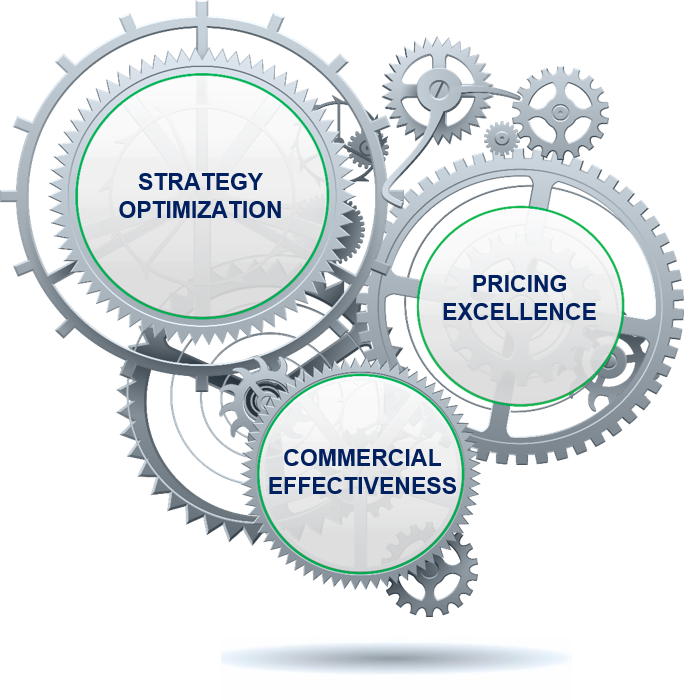
The shift we are seeing in leading organizations is clear: moving from isolated improvements to a fully integrated commercial system.
This transformation is structured around four elements:
Integrated decision framework Strategy, pricing economics, and market execution are aligned within a single governance model, ensuring consistent decision-making across levels.
Structured transformation sequence Early transparency on performance drivers enables focused implementation, followed by scalable deployment across business units and geographies.
Governed best practices at scale Data, analytics, and commercial processes are embedded into systems that standardize execution while preserving local adaptability.
Sustained performance by design Clear ownership, measurable ROI discipline, and capability transfer ensure that performance improvements are maintained over time.
AI plays a critical role in this context—not as a standalone initiative, but as an enabler embedded within the commercial system, accelerating data integration, decision support, and execution discipline.
CASE EXAMPLE
A global industrial manufacturing company operating across multiple regions faced increasing variability in pricing outcomes and limited visibility on deal-level profitability.
Situation Pricing frameworks existed, but were interpreted differently across regions. Data was available but fragmented, and decision-making relied heavily on local practices.
Intervention A structured Commercial Transformation program was implemented:• Creation of a Single Point of Truth integrating customer, product, and deal-level data• Deployment of gross-to-net transparency across all regions• Definition of governed pricing corridors linked to strategic objectives• Integration of AI-enabled analytics to support negotiation and scenario modeling• Alignment of incentives and execution practices across commercial teams
Results
+5% improvement in net price within 12 months
+10% increase in deal-level margin consistency
Significant acceleration in decision-making cycles
Full transparency across regions, enabling leadership-level governance
CONCLUSION
The evolution from pricing to sustainable competitive edge is not driven by isolated initiatives, but by the ability to connect strategy, pricing, and execution within a single, governed system.
Commercial Transformation, AI-Powered, provides the structure to achieve this—turning complexity into coordinated performance and enabling organizations to operate with clarity, speed, and discipline.
The question for leadership is no longer whether pricing can be optimized.
It is whether the organization is equipped with the systems and governance required to sustain performance at scale.


Comments