
From Innovation Leadership to Commercial Structural Control in Medical Devices

The Medical Devices industry is structurally complex.
Multi-country regulatory environments.
Hospital and public tender negotiations.
Distributor-based go-to-market models.
Innovation-driven product portfolios.
Constant pressure on net price and reimbursement.
Despite this sophistication, a recurring pattern appears across global MedTech organizations: margin erosion is rarely caused by product weakness.
It is caused by commercial fragmentation.
1. The Structural Problem
In most Medical Devices organizations, strategy, pricing and execution evolve independently.
Global teams define portfolio and pricing architecture.
Countries negotiate tenders under local pressure.
Sales teams operate with partial visibility on gross-to-net economics.
Finance reconstructs profitability after the fact.
The result:
Discount dispersion across hospitals and regions
Weak governance over tendering corridors
Incentive systems disconnected from margin discipline
Data silos between ERP, CRM, CPQ and BI
Slow, reactive decision-making
These are not operational inefficiencies.
They are structural commercial weaknesses.
Stratence benchmarking across 800+ projects shows that companies typically lose 4–12% of EBIT annually due to such structural misalignment.
2. Commercial Transformation as an Integrated Framework
Stratence Partners does not treat pricing, sales or systems as isolated initiatives.
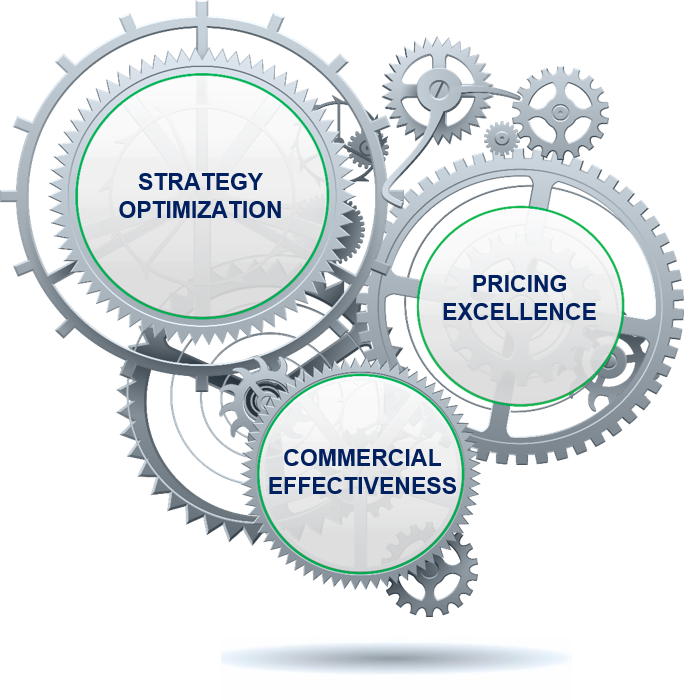
We implement Commercial Transformation as one unified framework integrating:
Strategy Optimization
Pricing & Contracting Excellence
Sales & Commercial Effectiveness
Pragmatic AI Digital Enablement
Capability Building & Governance
Through our proprietary SPIE+AI™ ecosystem, AI Powered, we structure Medical Devices organizations around three executive-facing pillars:
SPOT™ – Single Point of Truth for trusted data transparency
Gross-to-Net Waterfall – Full profitability visibility across dimensions
Strategic Corridors – Governance-driven negotiation and incentive execution
This is not about adding tools.
It is about redesigning how decisions are made, governed and executed.
3. What Changes in a MedTech Organization
When Commercial Transformation is implemented structurally:
Tender pricing becomes corridor-based, not ad-hoc
Discounting authority is governed, not negotiated emotionally
Sales incentives reinforce margin strategy
ERP, CRM and CPQ operate as one integrated ecosystem
Executive teams gain real-time, transaction-level economic clarity
The financial impact is measurable.
+3–7% EBIT within year one.
Short-term quick wins combined with long-term autonomy.
A self-funded transformation journey.
4. Executive Imperative
Medical Devices leaders are under pressure to balance growth, compliance, innovation and profitability.
Adding more analytics does not solve the problem.
Structural control does.
Commercial Transformation, AI Powered, is not a technology program.
It is a governance redesign.
Stratence Partners works with CEOs and executive committees to embed that redesign across multi-country MedTech organizations, ensuring that strategy, pricing and execution work as one.
A year from now, the competitive gap between disciplined and undisciplined commercial organizations will be wider.
The question is not whether transformation is needed.
It is whether it starts now or later.


Comments