
Gross-to-Net, Reimagined: Turning Pricing Complexity into Sustainable Revenue

Executive White Paper – EPA Congress, Amsterdam 2026
Fernando Ventureira, CEO – Stratence Partners
Introduction
If you were not able to attend the Evidence, Pricing & Access (EPA) Congress in Amsterdam, or if you could not join the workshop session I delivered on March 3rd, this document provides a detailed synthesis of the core ideas, frameworks, and practical implications discussed during that session.
The objective of the workshop was simple but fundamental.
Across Pharma and MedTech organizations, Gross‑to‑Net (GtN) is still treated primarily as a financial reconciliation exercise, when in reality it should be understood and managed as a strategic commercial capability.
In other words, the question is not merely:
"How do we report our net price correctly?"
The real executive question is:
"How do we design, govern, and execute the full pricing waterfall so that it systematically delivers sustainable revenue and margin performance?"
The distinction between these two perspectives is enormous.
Organizations that treat Gross‑to‑Net as a reporting issue are condemned to continuously explain margin erosion after the fact.
Organizations that manage Gross‑to‑Net as a strategic capability design the rules, levers, and governance mechanisms that shape commercial outcomes before they occur.
This white paper summarizes how leading organizations are making that transition.
1. Why Gross‑to‑Net Has Become a Strategic Priority

In Pharma and MedTech, commercial complexity has increased dramatically during the last decade.
Several structural forces are simultaneously affecting profitability:
Margin erosion across mature portfolios
Increasing payer pressure and rebate complexity
Market share volatility due to accelerated competition
Patent cliffs and generic or biosimilar pressure
Increasing launch costs and uncertainty
In this environment, price itself is rarely the only issue.
The real challenge lies in the interaction of multiple economic levers across the full pricing waterfall:
Gross Price
Discounts
Invoice price
Rebates
Sales incentives
Cost‑to‑sell
Cost‑to‑serve
COGS
Net‑Net profitability
Most organizations only see fragments of this waterfall.
Many can identify isolated leakages.
Very few can actively manage every lever in a coordinated manner.
This is precisely where Gross‑to‑Net discipline becomes critical.
2. The Pricing Waterfall: From Leakage Detection to Value Engineering
In many organizations, Gross‑to‑Net analysis is used only to detect problems.

Examples include:
Excessive rebates
Uncontrolled discounting
Misaligned contracting conditions
Unexpected margin erosion
But detection alone is not sufficient.
True best practice begins when leakages are intentionally engineered as performance levers.
This requires answering several fundamental questions:
1. Is the gross price positioned correctly relative to value?
2. Are discounts aligned with strategic segmentation or granted opportunistically?
3. Are rebates structured to drive performance or merely to secure volume?
4. Is cost‑to‑serve embedded in negotiation logic?
In organizations that master Gross‑to‑Net, the waterfall becomes a strategic design architecture, not an accounting artifact.
Each lever is explicitly defined, governed, and monitored.
3. End‑to‑End Gross‑to‑Net Transparency
The first prerequisite for managing Gross‑to‑Net effectively is full transparency.
Unfortunately, many organizations lack visibility across the full waterfall.
Typical situations include:
Fragmented data across finance, pricing, and sales systems
Different definitions of net price depending on the function
Lack of transaction‑level profitability visibility
Inability to reconcile contractual terms with actual execution
As a result, decision‑making becomes reactive.
Executives debate opinions rather than analyze economic facts.
Advanced organizations solve this by establishing a single, trusted economic view of the pricing waterfall.
This includes:
Transaction‑level profitability
Cross‑product and cross‑customer comparisons
Integrated contract and rebate visibility
Real‑time monitoring of commercial execution
Only with this transparency can organizations start managing Gross‑to‑Net proactively.

4. Scenario‑Based Pricing and Contracting Decisions
Once transparency is achieved, the next step is economic intelligence.
Leading organizations increasingly rely on scenario‑based simulations to guide pricing and contracting decisions.
Executives must continuously balance three competing objectives:
Access
Market share
Profitability
These trade‑offs are rarely intuitive.
For example:
A small price concession may unlock significant volume
A rebate reduction may have minimal access impact
A targeted discount could increase margin by improving portfolio mix
Scenario simulations allow organizations to answer key strategic questions such as:
What is the fastest path to +3% operating margin?
Where can share increase without margin erosion?
Which lever should move first: price, discount, rebate, or cost‑to‑serve?
With the right analytical capabilities, organizations can identify:
The SKUs with highest profit elasticity
Accounts with structural rebate inefficiencies
Segments with untapped market share opportunities
This transforms pricing decisions from negotiation intuition into data‑driven economic strategy.
5. Integrated Governance Across Finance, Market Access, and Commercial
One of the most critical findings across hundreds of transformation programs is this:
Gross‑to‑Net performance rarely fails because of pricing analytics.
It fails because of governance fragmentation.
In many organizations:
Finance owns reporting.
Pricing owns policies.
Market Access negotiates payer agreements.
Sales executes deals in the field.
Without integrated governance, the system inevitably breaks down.
Best‑practice organizations establish a structured economic governance framework including:
Clear decision rights
Defined escalation thresholds
Policy discipline
Exception management
Board‑level KPI visibility
This governance model ensures that pricing strategy, access agreements, and commercial execution remain aligned.

6. From Analysis to Execution at Scale
Another common failure point is the gap between analysis and execution.
Many organizations invest heavily in pricing analytics but fail to embed insights into daily decisions.
True transformation requires embedding Gross‑to‑Net discipline into the operating model of the organization.
This involves aligning four key dimensions:
Strategy
Pricing
Execution
Monitoring
But achieving this alignment also requires addressing the underlying organizational enablers.
These include:
People
Processes
Data
Systems
Mindset
Without alignment across these elements, even the most sophisticated pricing strategy will fail during execution.
7. The Cross‑Functional Gross‑to‑Net Operating Model
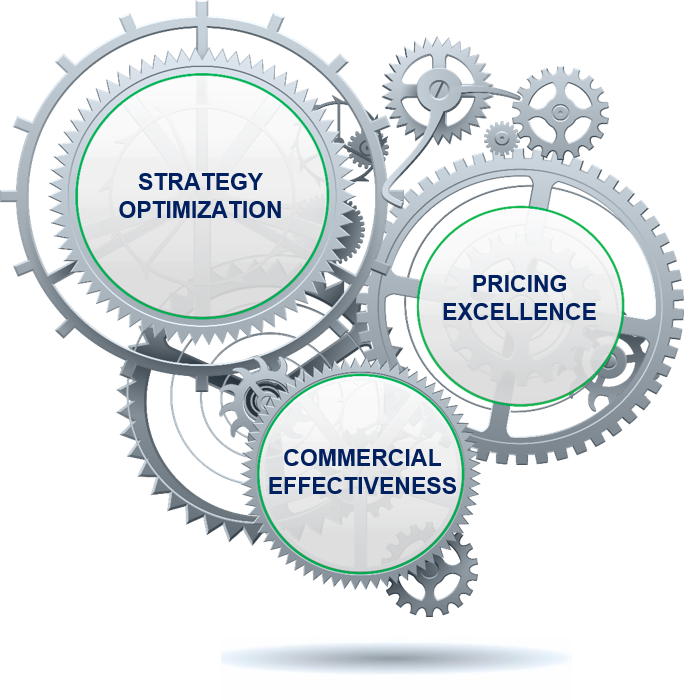
Organizations that successfully manage Gross‑to‑Net operate through an integrated cross‑functional framework.
At the center lies a unified economic architecture connecting:
Strategy optimization
Pricing excellence
Commercial execution
Surrounding this core framework are the operational enablers required to make it work:
Integrated data systems
Clear governance structures
Incentive alignment
Negotiation playbooks• Performance monitoring
When these elements function together, Gross‑to‑Net becomes a competitive capability.
8. The Role of AI‑Powered Commercial Intelligence
Modern Gross‑to‑Net optimization increasingly relies on AI‑powered analytics.
However, it is important to clarify a common misconception.
Artificial intelligence does not replace commercial judgement.
Its role is to:
Accelerate data integration
Reveal hidden economic patterns
Simulate strategic scenarios
Support decision‑making with quantified insights
When properly integrated into commercial governance, AI becomes a powerful accelerator of strategic discipline.
9. What Best‑Practice Organizations Are Doing Today
Across industries, the most advanced organizations share several characteristics.
They:
Treat Gross‑to‑Net as a strategic capability.
Operate with full pricing waterfall transparency.
Use scenario simulations to guide pricing decisions.
Align Finance, Market Access, and Commercial governance.
Embed pricing discipline into execution systems.
Develop cross‑functional accountability for profitability.
These organizations no longer react to margin erosion.
They design their commercial system to prevent it.
10. Executive Takeaways
The key lessons from this session can be summarized in four principles.
Gross‑to‑Net must be treated as a strategic commercial capability rather than a financial report.
Transparency across the pricing waterfall is essential for informed decision‑making.
Scenario‑based simulations enable organizations to navigate complex trade‑offs between access, volume, and margin.
Integrated governance across Finance, Market Access, and Commercial ensures disciplined execution.
Organizations that master these four dimensions transform pricing complexity into sustainable performance.
Final Perspective
Over the last decades working with executive teams across industries, one observation consistently holds true.
Commercial performance is rarely destroyed by a single wrong decision.
It is eroded gradually by thousands of small, uncoordinated decisions across pricing, contracting, and execution.
Gross‑to‑Net discipline is the mechanism that aligns those decisions.
When properly designed and embedded, it becomes one of the most powerful engines for profitable growth.
And when combined with modern analytics and AI‑powered commercial intelligence, it enables organizations to move from reactive pricing management to systematic strategic control of revenue and margin performance.
That is the real meaning of Gross‑to‑Net, reimagined.
Fernando Ventureira CEO – Stratence Partners


Comments