
Commercial Transformation in IT: Turning Data into Commercial Control

Why technology companies need structured decision architecture, pricing governance and execution discipline to protect growth and profitability.
Technology companies have invested heavily in data, analytics, automation and AI.
Yet many continue to face the same structural challenge:
Commercial decisions are becoming faster, but not necessarily better.
Pricing exceptions increase
Discounting expands
Product portfolios become more complex
Regional teams operate with different commercial logics
Data grows exponentially while decision consistency deteriorates
The consequence is rarely visible in a single transaction.
It appears gradually through margin leakage, inconsistent execution, slower strategic alignment and reduced profitability.
This is not a technology problem.
It is a Commercial Transformation challenge.
What Is Really Happening
Most IT organizations possess sophisticated systems.
CRM platforms
CPQ solutions
Business intelligence environments
Advanced analytics
AI initiatives
The issue is that these capabilities often evolve independently.
Sales follows one logic
Finance follows another
Product management operates through different priorities
Regional organizations adapt execution according to local realities
The result is fragmentation.
Organizations end up with multiple versions of commercial truth, inconsistent pricing decisions and limited visibility into the real economic drivers of performance.
Data becomes abundant.
Decision architecture becomes scarce.
The challenge is not access to information.
The challenge is governing how decisions are made.
Business Impact
Across software, SaaS, technology services and digital platform organizations, we frequently observe structural weaknesses that erode profitability:
Lack of transaction-level profitability visibility
Inconsistent pricing and discounting practices
Misalignment between strategic objectives and field execution
Slow response to changing market dynamics
Limited control of gross-to-net performance
Margin leakage hidden within commercial processes
Over time, these issues compound.
Organizations can lose between 4% and 12% of EBIT through structural commercial inefficiencies that remain largely invisible until performance begins to deteriorate.
The problem is rarely strategy.
The problem is execution discipline.
What Needs to Change
High-performing technology organizations operate differently.
They do not simply invest in more systems.
They create a Commercial Transformation operating model.
This requires four interconnected dimensions:
Commercial Transformation
A structured framework connecting strategy, pricing, governance and execution into a single operating model.
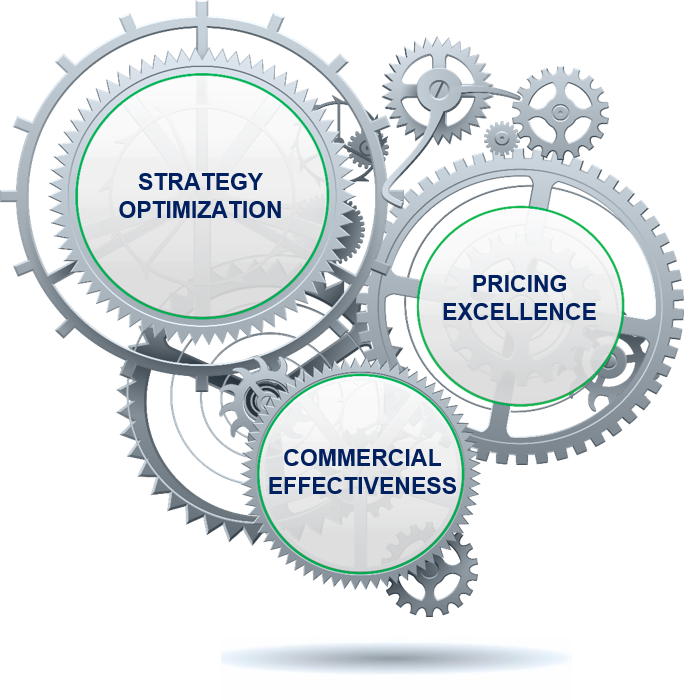
Strategy Optimization
Clear market priorities, customer segmentation, portfolio focus and decision rights aligned across the organization.
Pricing Excellence
Governance mechanisms that protect value, improve negotiation consistency and eliminate uncontrolled discounting.
Commercial Effectiveness
Execution systems ensuring that strategic decisions are translated consistently into day-to-day commercial behavior.
Only when these elements operate together can organizations create sustainable commercial autonomy.
AI Powered capabilities then become a force multiplier rather than an isolated initiative.
Case Example
Situation
A global software company operating across multiple regions experienced strong revenue growth but declining profitability.
Pricing decisions varied significantly between regions, discount approvals lacked consistency and management had limited visibility into transaction-level profitability.
Intervention
A Commercial Transformation program was implemented using an integrated framework connecting strategy, pricing governance, commercial execution and AI Powered decision support.
A Single Point of Truth was established across CRM, CPQ, ERP and reporting environments.
Structured pricing corridors, approval workflows and profitability visibility were embedded into commercial operations.
Measurable Impact
5.2% EBIT improvement within twelve months
Significant reduction in pricing variability
Faster decision cycles
Improved alignment between global strategy and regional execution
Sustainable governance embedded into daily operations
The outcome was not better reporting.
The outcome was better decisions.
Conclusion
Technology companies do not need more dashboards.
They need greater control over how commercial decisions are made.
The organizations creating sustainable competitive advantage are not necessarily those with the most data.
They are the ones that connect strategy, pricing, governance and execution within a disciplined Commercial Transformation operating model.
AI Powered systems can accelerate performance.
But only when they support structured decision-making.
The question for executive teams is straightforward:
Does your organization have more data than ever before—or more control over the decisions that truly drive performance?


Comments