
Industrial Commercial Transformation Is Becoming an Execution Discipline Problem
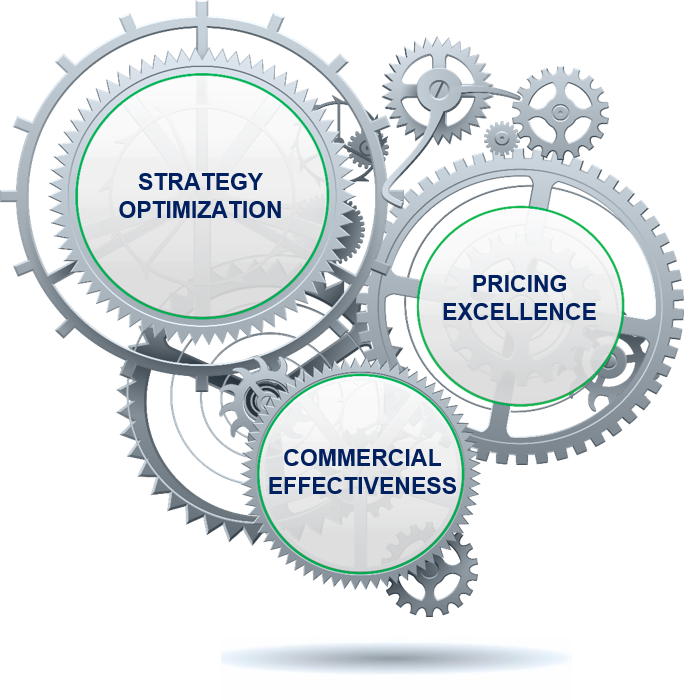

Why Industrial Organizations Are Reassessing the Link Between Strategy, Pricing, Operations, and Commercial Execution
Full Article
Industrial organizations are operating under increasing structural pressure.
Margin volatility, fragmented pricing governance, unstable demand patterns, rising operational costs, and commercial complexity are converging simultaneously. Yet in many industrial environments, strategy, pricing, sales execution, and operational decision-making still operate as disconnected layers.
The consequence is not usually visible through one isolated KPI.
It appears progressively through margin erosion, inconsistent commercial behavior, delayed decision-making, uncontrolled discounting, pricing exceptions, weak cross-functional alignment, and increasing difficulty translating strategy into measurable field execution.
This is where Commercial Transformation is becoming a structural executive priority rather than a tactical initiative.
At Stratence Partners, we increasingly observe that industrial companies are not struggling because they lack strategy.
They struggle because execution architecture, pricing governance, commercial operating models, and decision systems are not sufficiently aligned to sustain performance under complexity.
And complexity in industrial environments is accelerating.
Multiple business units, country organizations, distributors, tendering environments, fluctuating raw material costs, customized agreements, contract variability, and heterogeneous ERP landscapes create operational fragmentation that traditional management structures often cannot fully govern at scale.
The issue is rarely only commercial.
It is structural.
What Is Really Happening
Many industrial organizations still manage commercial performance through fragmented processes and local decision logic.
Pricing teams operate separately from sales.
Sales incentives are disconnected from profitability logic.
Commercial decisions depend on spreadsheets with inconsistent data sources.
Strategy evolves faster than execution capabilities.
Market intelligence remains decentralized.
AI initiatives exist, but outside operational workflows.
The result is an execution gap.
Not because organizations lack talent.
But because the operating model itself no longer supports decision speed, governance discipline, or scalable execution consistency.
In industrial sectors especially, this creates cumulative margin leakage.
A discount approved in one region affects global positioning.An inconsistent pricing corridor impacts negotiation authority. A disconnected rebate structure erodes profitability silently over time. Fragmented commercial systems reduce visibility across the gross-to-net waterfall.
Most organizations see the symptoms.
Fewer quantify the structural causes.
Why AI Alone Will Not Solve the Problem
Many industrial companies are now accelerating investments in AI.
But AI deployed without governance architecture, data discipline, operational integration, and execution ownership often increases complexity rather than reducing it.
Industrial organizations do not need isolated AI pilots disconnected from business reality.
They need AI Powered commercial systems embedded into decision architecture.
That means:
aligned data governance,
integrated commercial workflows,
trusted profitability visibility,
measurable pricing economics,
execution discipline,
and adoption mechanisms across the organization.
AI becomes valuable when it strengthens commercial control, decision quality, and execution consistency.
Not when it becomes another disconnected layer.
This distinction is becoming increasingly important at executive level.
The Business Impact
When Commercial Transformation is addressed structurally, industrial organizations can significantly improve:
pricing consistency,
gross-to-net transparency,
sales execution discipline,
negotiation quality,
speed of commercial decisions,
profitability visibility,
and cross-functional alignment.
The economic impact is often material.
Not only through net price improvement, but through:
reduced margin leakage,
improved governance,
faster execution cycles,
better resource allocation,
and stronger commercial autonomy.
The organizations creating sustainable performance improvements are not necessarily the ones with the most technology.
They are the ones capable of aligning:
strategy,
pricing,
execution,
systems,
governance,
and operational behaviors into one coherent commercial framework.
What Needs To Change
Industrial Commercial Transformation can no longer be approached as isolated projects.
Organizations increasingly require:
integrated commercial operating models,
unified pricing governance,
embedded decision architecture,
connected data ecosystems,
scalable execution discipline,
and AI Powered enablement integrated directly into operational workflows.
This requires combining:
Strategy Optimization,
Pricing Excellence,
Commercial Effectiveness,
Data Management,
Data Science,
and Integrated Commercial Systems.
Not as parallel initiatives.
As one operating framework.
At Stratence Partners, this is precisely where Commercial Transformation becomes measurable.
Not theoretical.
Case Example
A multinational industrial manufacturer operating across Europe and North America was facing increasing margin pressure despite stable revenue growth.
The organization had:
decentralized pricing practices,
inconsistent rebate structures,
fragmented CRM and ERP visibility,
and limited governance over commercial exceptions.
Commercial decisions depended heavily on local negotiation practices, reducing strategic consistency and weakening profitability transparency.
Stratence Partners supported the organization through a phased Commercial Transformation program focused on:
gross-to-net transparency,
pricing governance redesign,
commercial execution alignment,
integrated data visibility,
and AI Powered commercial analytics embedded into operational workflows.
Within the first year, the organization achieved:
measurable reduction in uncontrolled discounting,
improved negotiation consistency,
faster commercial decision-making,
stronger cross-functional alignment,
and EBIT improvement linked directly to pricing and execution discipline.
More importantly, the company embedded internal capabilities allowing future autonomy rather than permanent consulting dependency.
Conclusion
Industrial organizations are entering a phase where commercial complexity can no longer be managed through fragmented structures.
The organizations that will outperform structurally are those capable of embedding governance, pricing economics, execution discipline, AI Powered systems, and commercial autonomy into one integrated operating model.
Because in industrial environments, sustainable profitability is rarely determined by strategy alone.
It is determined by how consistently the organization can execute it.
How is your organization currently balancing pricing governance, operational complexity, and commercial execution discipline across regions, products, and customers?


Comments