
Commercial Transformation in Animal Health: Why Commercial Complexity Is Outpacing Operating Models

Animal Health organizations are facing increasing pricing, channel, portfolio, and market-access complexity, while many commercial operating models remain structurally fragmented.
Commercial Transformation in Animal Health: Why Commercial Complexity Is Outpacing Operating Models.
Animal Health organizations are facing increasing pricing, channel, portfolio, and market-access complexity, while many commercial operating models remain structurally fragmented.
The Animal Health industry is entering a structurally different commercial environment.
Growth remains attractive across companion animals, livestock, nutrition, diagnostics, and preventive care. But beneath that growth, commercial complexity has increased significantly.
Many organizations are now operating with:
Multiple pricing logics across regions and product categories
Increasing distributor dependency
Fragmented commercial data environments
Inconsistent gross-to-net visibility
Growing pressure on commercial execution discipline• Expanded portfolio complexity after acquisitions
Higher expectations for field effectiveness and account-level precision• AI experimentation without governance integration
The issue is no longer lack of commercial ambition.
The issue is whether the operating model can still support profitable execution at scale.
This is where Commercial Transformation becomes critical.
Not as a consulting initiative.
As a structural operating capability.
What Is Really Happening
In many Animal Health organizations, commercial systems evolved faster than governance models.
Regional pricing structures were added incrementally.Distributor frameworks expanded independently.Commercial incentives evolved by business unit.Market access logic became more fragmented.Customer segmentation changed.Portfolio structures became more complex.
But decision architecture often remained disconnected.
As a result, many leadership teams now face a familiar situation:
The organization appears commercially active, but economically opaque.
This creates several structural risks.
Pricing corridors become inconsistent across markets.Commercial autonomy varies significantly between regions.Data reliability weakens executive decision speed.Margin leakage becomes difficult to isolate.Forecasting quality deteriorates.Field execution becomes dependent on local interpretation rather than governed commercial frameworks.
The problem is rarely visible through topline growth alone.
It usually appears through execution inconsistency, profitability pressure, channel friction, rebate complexity, commercial inefficiencies, and slower organizational responsiveness.
In Animal Health specifically, this becomes even more critical because organizations often operate across highly differentiated customer ecosystems:
Veterinary clinics
Hospital groups
Distributors
Producers
Retail chains
Integrated livestock operations
Regulatory environments with varying economic pressures
The commercial operating model must absorb this complexity without losing economic discipline.
Many organizations are reaching the limits of fragmented commercial structures.
Business Impact
The consequences are operational, financial, and strategic.
Organizations may continue growing while simultaneously losing commercial efficiency.
Typical impact areas include:
Margin erosion hidden inside gross-to-net structures
Discounting, rebates, distributor agreements, promotional structures, and regional exceptions accumulate over time without sufficient visibility.
The result is often gradual EBIT erosion that remains structurally under-managed.
Reduced pricing governance
Pricing decisions become increasingly decentralized without sufficient decision rights clarity.
Commercial teams optimize locally.The enterprise loses consistency globally.
Slower strategic execution
When commercial data architecture is fragmented, leadership teams spend excessive time validating information instead of executing decisions.
Decision speed becomes constrained by system fragmentation.
Field execution inconsistency
Sales teams frequently operate with different assumptions, priorities, or commercial frameworks across regions.
Adoption quality varies.Commercial discipline weakens.
AI initiatives without operating integration
Many organizations are exploring AI capabilities.
But without governance integration, commercial process alignment, data consistency, and execution discipline, AI simply accelerates fragmentation.
AI Powered Commercial Systems only generate measurable value when embedded inside governed commercial operating models.
What Needs to Change
Commercial Transformation in Animal Health requires a structural approach.
Not isolated initiatives.Not disconnected technology deployments.Not standalone pricing projects.
The organizations creating sustainable advantage are increasingly focused on five structural dimensions.
Commercial decision architecture Organizations need clear governance models for pricing, account management, rebates, segmentation, commercial authority, and market execution.
Decision rights must become explicit.
Gross-to-net transparency
Leadership teams require visibility across the full economic chain.
Not only list price performance.But actual realized commercial economics.
Integrated commercial data environments
Commercial transformation depends on reliable decision environments.
Organizations need consistent commercial data structures capable of supporting pricing governance, forecasting, field effectiveness, and strategic planning.
Execution discipline and adoption
Commercial frameworks only create value when embedded operationally.
Capability transfer, field adoption, governance routines, and execution consistency become critical success factors.
AI Powered enablement with governance integration
AI should support commercial effectiveness.
Not replace governance.
The most effective organizations are using AI Powered Commercial Systems pragmatically:
Commercial analytics acceleration
Pricing intelligence
Forecasting enhancement
Commercial insight generation
Sales effectiveness support• Decision support environments
But always inside structured governance frameworks.
Case Example
A multinational Animal Health organization operating across companion animal and livestock segments faced increasing pricing inconsistency across regions after multiple acquisitions.
The company had strong topline growth, but leadership identified growing margin pressure and inconsistent commercial execution.
Situation
Regional pricing structures evolved independently
Distributor agreements lacked global visibility
Commercial reporting definitions varied by geography
Forecasting accuracy deteriorated
Field execution discipline became inconsistent
Commercial systems were fragmented across business units
Intervention
The organization initiated a Commercial Transformation program focused on:
Commercial governance redesign
Gross-to-net visibility improvement
Pricing corridor alignment
Integrated commercial reporting structures
Commercial decision-rights clarification
AI Powered commercial analytics enablement
Cross-functional execution governance
The objective was not centralized control.
The objective was governed commercial autonomy.
Measurable Impact
Within 18 months, the organization achieved:
Improved pricing consistency across key regions
Faster executive decision cycles
Increased visibility into margin leakage drivers
Higher forecasting reliability
Stronger field execution alignment
Improved commercial adoption discipline
Measurable EBIT improvement linked to pricing governance and execution consistency
Most importantly, leadership gained greater confidence in commercial decision quality.
Conclusion
The Animal Health industry is not facing a growth problem.
It is facing an operating model pressure problem.
Commercial complexity has increased faster than governance maturity in many organizations.
The companies that will create sustainable advantage are unlikely to be those with the largest number of initiatives.
They will be the organizations capable of building disciplined Commercial Transformation operating models that integrate pricing governance, execution discipline, commercial data architecture, and AI Powered enablement into one coherent decision environment.
This is increasingly becoming a leadership issue.
Not a technology issue.
Not a reporting issue.
Not a sales issue.
A commercial operating model issue.
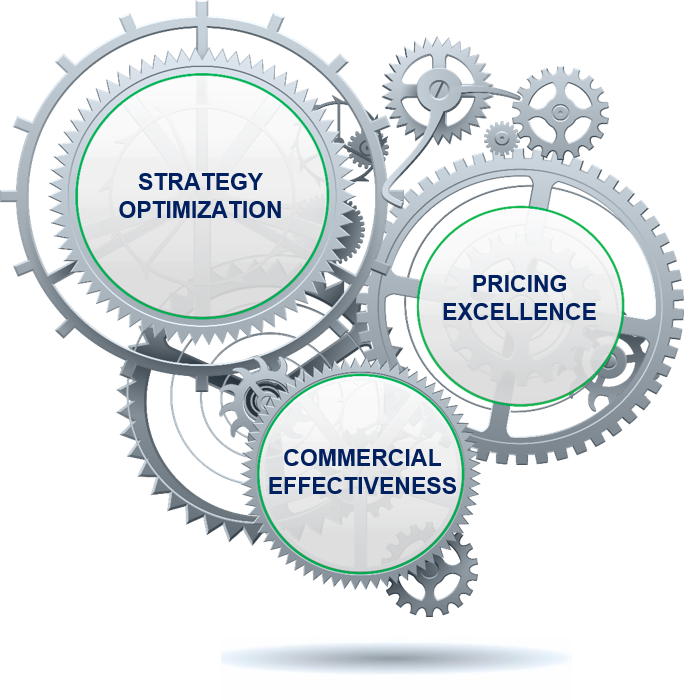
At Stratence Partners, Fernando Ventureira and the global VP team continue working with organizations across complex industries to help embed Commercial Transformation as a measurable operating capability connected to pricing excellence, governance discipline, commercial effectiveness, and AI Powered Commercial Systems.
The executive question is becoming increasingly clear:
Is your commercial operating model truly designed for the complexity your organization is already managing?


Comments