
Why Commercial Transformation Still Fails Without Cross-Functional Execution Discipline

Why Commercial Transformation Still Fails Without Cross-Functional Execution Discipline
At the recent Operational Excellence & Process Transformation Summit in Munich, Greg Varner, Senior Vice President North America and Advisory Board Member at Stratence Partners, shared executive reflections around one of the most important realities currently affecting transformation programs globally:
Technology alone does not transform organizations.

Processes only work when people understand them, trust them, and operate within them consistently.
AI alone does not transform organizations.
Operating models alone do not transform organizations.
Transformation ultimately succeeds or fails through people — specifically through leadership alignment, execution discipline, organizational energy, and the ability of organizations to collaborate effectively across functions.
One of the strongest and most consistent themes emerging throughout the summit discussions was that many organizations continue overestimating the role of technology while underestimating the complexity of organizational alignment.
Because sustainable transformation is not simply about implementing systems.
It is about creating environments where people, governance, processes, incentives, and execution models operate coherently together.
This message resonated strongly throughout the conference discussions, particularly among organizations facing increasing operational complexity while simultaneously accelerating AI, digitalization, and transformation initiatives.
Many executive discussions repeatedly returned to the same concern:organizations are often investing heavily in transformation technologies while underestimating the organizational effort required to sustain adoption, execution discipline, and cross-functional collaboration over time.
Across industries, many organizations continue investing heavily in:
AI programs,
analytics platforms,
pricing technologies,
CRM environments,
process transformation initiatives,
and digital operating models.
Yet measurable business impact often remains inconsistent.
At Stratence Partners, we consistently observe the same structural challenge:strategy, pricing, sales, operations, finance, data, and execution continue operating in parallel rather than as one integrated commercial framework.
And when this happens, transformation friction accelerates.
Organizations experience:
slower decision-making,
inconsistent execution,
duplicated initiatives,
weak governance,
fragmented incentives,
margin leakage,
and increasing operational complexity.
One of the strongest themes emerging from the summit discussions was that many organizations are unintentionally increasing transformation complexity by layering technology on top of fragmented operating models.
Technology matters enormously.
AI matters enormously.
But disconnected execution environments cannot be solved through technology alone.
This is precisely why Commercial Transformation must be approached as an integrated executive operating model — not as isolated projects.
At Stratence Partners, our focus is not simply digital enablement or standalone AI initiatives.
Our priorities remain:
Commercial Transformation,
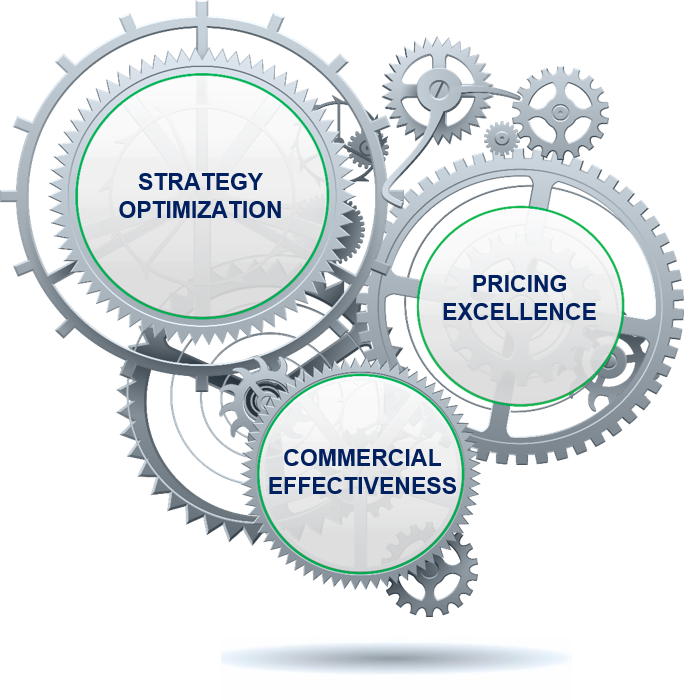
Strategy Optimization, Pricing Excellence and Commercial Effectiveness,
proprietary solutions for Data Management, Data Science and Integrated Commercial Systems,
and pragmatic AI-Powered execution environments.
The objective is not to automate dysfunction.
The objective is to align decision architecture, governance, incentives, commercial execution, and operational capabilities into one coherent framework.
Because sustainable transformation requires organizations to operate cross-functionally with clarity and discipline.
Another important theme repeatedly highlighted during executive discussions in Munich was the growing level of transformation fatigue inside organizations.
Many teams are overwhelmed by:
disconnected initiatives,
overlapping transformation programs,
excessive reporting structures,
fragmented ownership,
and unclear execution accountability.
As a result, organizations often lose operational coherence even while investing heavily in transformation.
This is where leadership alignment becomes critical.
Commercial Transformation only scales when leadership teams:
define unified priorities,
create transparent governance,
align incentives,
simplify decision-making,
and embed execution accountability across functions.
Technology can accelerate transformation.
AI can improve decision support.
Data systems can increase visibility.
But none of those elements replace organizational alignment.
And this is increasingly becoming one of the defining differentiators between organizations that achieve measurable transformation outcomes and those that remain trapped in permanent transformation cycles without structural performance improvement.
At Stratence Partners, we continue helping organizations redesign the full commercial framework of Strategy, Pricing, and Execution through integrated transformation models capable of improving:
profitability,
governance,
commercial effectiveness,
decision speed,
margin transparency,
and execution consistency.
Because Commercial Transformation is not primarily a technology challenge.
It is an execution challenge.
And execution is always cross-functional.


Comments