
From Data Abundance to Decision Discipline in IT Organizations

Intro
IT companies operate in data-rich environments with advanced analytics, AI capabilities and sophisticated systems. Yet, many continue to experience structural margin erosion and inconsistent commercial performance.
The issue is not data.
It is decision architecture.
At Stratence, we structure this through SPIE (Strategy, Pricing, Implementation & Execution) — ensuring that decisions are not only defined, but executed consistently.
The Hidden Source of Margin Erosion
Across IT organizations, we consistently observe:
Lack of gross-to-net transparency at transaction level
Inconsistent pricing decisions across regions and teams
Misalignment between strategy, pricing and execution
Rapid deal cycles without structured governance
Fragmented data across CRM, CPQ, BI and financial systems
These structural gaps typically result in 4–12% EBIT loss.
Why More Data Does Not Solve the Problem
Many organizations invest in:
Data lakes
AI pilots
Pricing tools
Without a decision framework, these initiatives increase complexity.
They do not improve control.
Data without governance accelerates inconsistency.
The Missing Layer: Decision Architecture
High-performing IT organizations do not win by having more data.
They win by structuring how decisions are made:
Clear ownership of pricing and commercial decisions
Defined decision corridors aligned with strategy
Integrated economic logic across products, customers and deals
Real-time visibility on profitability drivers
This is where most organizations fail.
The Stratence Approach (SPIE Framework)
Commercial Transformation, through SPIE, integrates four dimensions into one operating model:
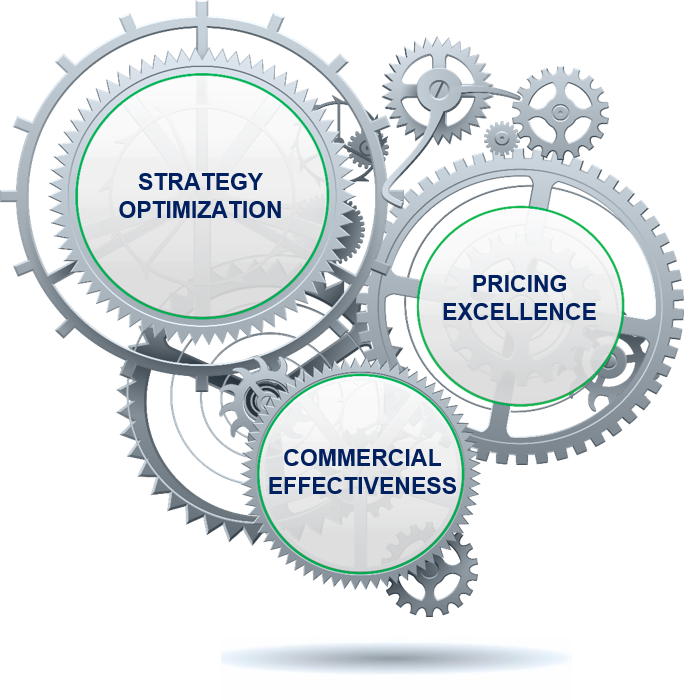
Strategy Optimization → Where and how to compete
Pricing Excellence → How value is captured and protected
Commercial Effectiveness → How execution is enforced
AI Powered Systems → How decisions are enabled at scale
Through SPIE+AI™, we establish:
A Single Point of Truth (SPOT™) integrating ERP, CRM, CPQ and BI
Full Gross-to-Net waterfall transparency at transaction level
Structured pricing corridors guiding negotiation and execution
Real-time decision support embedded into daily operations
From Data to Execution Discipline
The objective is not better reporting.
It is disciplined execution.
This requires:
Governance frameworks embedded in systems
Aligned incentives across functions and geographies
Clear negotiation authority and discount corridors
Continuous feedback loops between strategy and field execution
Implementation Logic (Not a One-Off Project)
Successful IT organizations approach this as a transformation journey:
Diagnostic → Identify structural margin leakage and decision gaps
Quick Wins → Capture immediate EBIT impact
System Design → Build integrated decision architecture
Implementation → Embed governance, tools and processes
Capability Building → Ensure long-term autonomy
This is not advisory alone.
It is implementation with measurable impact.
Measurable Impact
+3–7% EBIT improvement within year one
Faster, more reliable and auditable decisions
Structural reduction of margin leakage• Increased alignment across functions and regions
Conclusion
IT leaders do not need more dashboards.
They need control.
Control over how decisions are made.
Control over how pricing is executed.
Control over how strategy translates into performance.


Comments