
Commercial Performance Rarely Fails Inside One Function
The biggest losses appear in the gaps between Strategy, Pricing, Commercial Execution, Data and Systems.
Most organizations do not suffer from a lack of expertise.
They have experienced strategy teams. Pricing specialists. Strong sales organizations. Finance. Data teams. Technology platforms. Increasingly, they also have access to powerful AI capabilities.
And yet margin still leaks, growth opportunities remain underexploited, decisions take too long, and commercial execution does not consistently reflect strategic intent.
Why?
Because commercial performance is rarely determined by how well each individual function operates in isolation.
It is determined by how well they operate together.
That is where Commercial Transformation begins.
The problem is often between the functions
A strategy can be analytically sound and still fail commercially if it cannot be translated into clear pricing architecture, negotiation boundaries and field execution.
A pricing strategy can be sophisticated and still destroy value if sales teams are rewarded for behaviors that contradict it.
A company can possess enormous amounts of data and still make slow or inconsistent decisions if that data is fragmented, disputed or disconnected from commercial workflows.
Technology can automate processes without improving performance when the underlying processes, governance and decision rights remain unclear.
And AI can accelerate almost anything.
Including a poorly designed commercial system.
The challenge is therefore not simply to improve Strategy, Pricing, Sales, Data or Technology independently.
It is to create one coherent commercial framework in which decisions, economics, execution and information reinforce each other.
From Strategy to measurable commercial execution
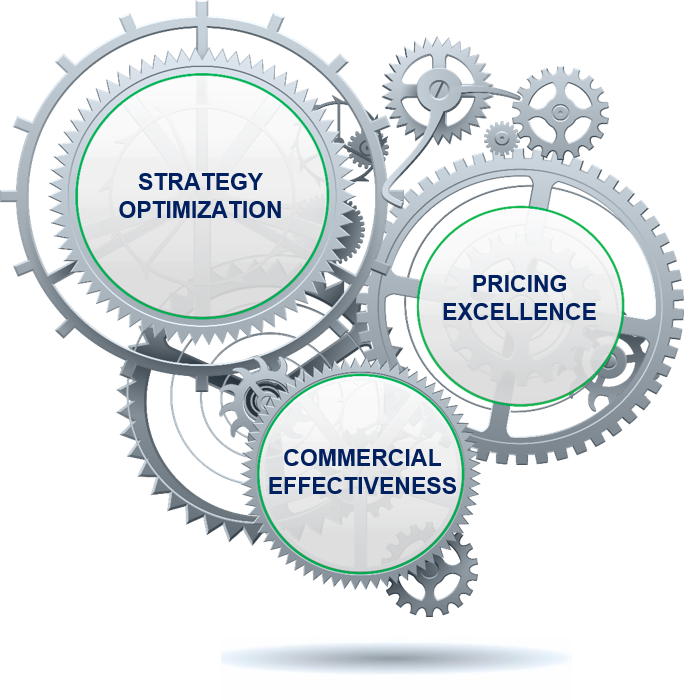
At Stratence Partners, we approach Commercial Transformation across three fundamental dimensions:
Strategy Optimization
Where should the organization grow? Which markets, customers, products and value propositions deserve priority? How should resources be allocated? What are the economic consequences of different strategic scenarios?
Strategy becomes significantly more valuable when it moves beyond annual planning and becomes a dynamic commercial decision framework.
Pricing Excellence
Pricing is not simply about setting prices.
It requires visibility into true profitability, gross-to-net economics, willingness to pay, discounting behavior, contracting, value creation and competitive dynamics.
Pricing Excellence creates the economic discipline required to protect value while supporting sustainable growth.
Commercial Effectiveness
Strategy and pricing only generate impact when they change what happens in the field.
Roles, incentives, governance, negotiation authority, processes, sales tools and commercial behaviors must all support the same strategic and economic objectives.
That is where strategy becomes execution.
Data and systems must support decisions; not create another layer of complexity
Commercial organizations increasingly operate across multiple ERP, CRM, CPQ, BI and analytical environments.
The issue is rarely the absence of technology.
The issue is whether those systems create trusted transparency and faster, better commercial decisions.
That requires disciplined Data Management, advanced Data Science and Integrated Commercial Systems capable of connecting market information, customer economics, pricing performance and commercial execution.
Stratence combines these capabilities with proprietary methodologies and solutions designed to create a more auditable and actionable commercial environment.
Not more dashboards.
Better decisions.
Where AI Powered creates real value
AI is extremely powerful when applied to the right commercial architecture.
It can accelerate data integration, detect patterns, improve analytical precision, support scenario modeling, strengthen decision-making and provide commercial teams with better information at the point of execution.
But AI should not become an isolated transformation agenda.
At Stratence, AI Powered capabilities are embedded within the broader Commercial Transformation framework—supporting Strategy, Pricing, Data and Commercial Execution rather than replacing the disciplines that make them effective.
Our SPIE+AI™ ecosystem is one example of that philosophy: connecting data, intelligence and commercial execution inside a coherent decision environment.
Expertise means implementation
Commercial Transformation does not end when the analysis is complete.
Organizations need new capabilities to operate successfully after external advisors leave.
That means embedding the transformation across:
People. Organization. Governance. Processes. Data. Systems.
It also means transferring capabilities, training teams and establishing the governance required to sustain performance independently.
That is why our work extends from diagnostic and design through implementation, capability building and scale.
The objective is not simply to recommend what should change.
It is to make the change work in the real organization.
One commercial system. One direction.
The strongest commercial organizations do not allow Strategy, Pricing, Sales, Data and Technology to evolve as separate agendas.
They connect them.
Because the most important commercial question is rarely:
“Which function needs another initiative?”
The better question is:
“Where are we losing value between strategy, economics, decisions and execution?”
That is where the next source of profitable growth is often hiding.
Stratence PartnersCommercial Transformation | AI Powered
A Collaborating Firm of Andersen Consulting
Comments