
From Strategy to Sustainable Competitive Edge: Why Commercial Transformation Must Become a Managed Operating System
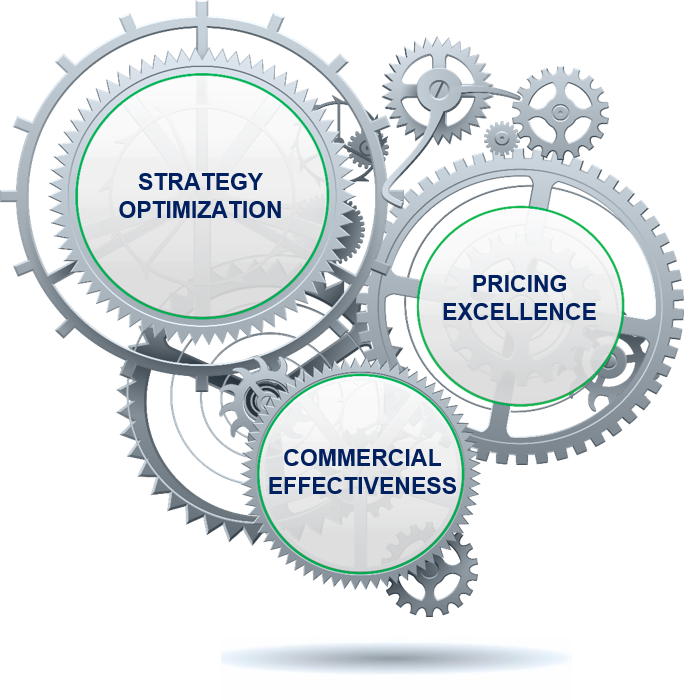

How leading organizations are connecting strategy, pricing economics, data intelligence, governance, and execution to create measurable and sustainable commercial performance.
At a time when organizations have more data, more analytics, and more technology than ever before, many executive teams still struggle with a familiar challenge:
How do we consistently convert strategy into measurable commercial results?
The issue is rarely the quality of the strategy itself.
Most organizations have growth ambitions, pricing objectives, commercial initiatives, and transformation roadmaps. Yet despite substantial investments, execution often remains fragmented across functions, systems, and decision-making processes.
The result is not failure.
The result is unrealized potential.
The gap between strategic intent and sustainable performance remains one of the most important opportunities for executive leadership today.
As consumer markets become increasingly dynamic, pricing decisions, revenue growth initiatives, portfolio management, commercial investments, and market execution can no longer operate as independent disciplines.
They must function as part of one integrated commercial system. (consumerpricingusa.ardensi.com)
The Market Is Not Lacking Strategy. It Is Lacking Integration.
Across industries, executive teams continue to strengthen individual capabilities:
Pricing teams improve analytics.
Commercial teams enhance execution.
Finance increases visibility.
Technology teams accelerate digital initiatives.
AI programs continue to expand.
The challenge is that these capabilities frequently evolve in parallel rather than as a unified framework.
Organizations often manage strategy, pricing economics, commercial execution, customer profitability, data management, and performance governance through disconnected structures.
When this happens, decision quality becomes inconsistent.
Visibility decreases.
Execution speed slows.
And opportunities remain difficult to scale.
The organizations generating the most sustainable results are not necessarily those with the most sophisticated tools.
They are the organizations that have created a disciplined decision architecture connecting strategic priorities with pricing, commercial execution, governance, and measurable accountability.
Competitive Advantage Is Built Through Systematic Alignment
Sustainable competitive advantage rarely emerges from isolated initiatives.
It is created when organizations establish an integrated framework that aligns:
Strategy and market priorities
Pricing economics and profitability objectives
Commercial execution and negotiation authority
Data transparency and decision intelligence
Governance and accountability
Capability building and organizational autonomy
This alignment creates consistency across decisions while maintaining the agility required to respond to changing market conditions.
The objective is not simply improving individual decisions.
The objective is improving the entire decision-making system.
A Structured Transformation Sequence
Organizations that consistently outperform competitors tend to follow a similar transformation path.
1. Create Transparency
Before improvement can occur, organizations must establish visibility.
This includes customer profitability, gross-to-net performance, pricing dispersion, commercial effectiveness, and decision ownership.
Transparency creates a common understanding of reality.
2. Focus Implementation
Transformation initiatives generate greater impact when priorities are concentrated on the highest-value opportunities.
Rather than attempting to optimize everything simultaneously, leading organizations focus on the capabilities that drive the greatest commercial leverage.
3. Scale Through Governance
Best practices become sustainable when governance structures ensure consistency across business units, regions, and functions.
Governance transforms isolated success into organizational capability.
4. Build Long-Term Autonomy
The ultimate objective of Commercial Transformation is not dependency.
It is organizational self-sufficiency.
Organizations create lasting advantage when teams possess the tools, processes, capabilities, and ownership required to sustain performance independently.
Case Example
A multinational consumer products organization was experiencing strong revenue growth but inconsistent profitability across markets.
Despite multiple pricing initiatives, executive leadership lacked visibility into margin drivers, customer profitability, and commercial execution consistency.
The organization launched a structured Commercial Transformation program focused on:
Integrated pricing governance
Gross-to-net transparency
Commercial performance intelligence
Cross-functional decision ownership
Standardized execution frameworks
Within twelve months:
Pricing consistency improved significantly across regions.
Decision-making cycles were reduced by more than 40%.
Commercial investments became more targeted.
Margin performance increased by 5%.
Leadership teams gained real-time visibility into profitability drivers and commercial execution.
Most importantly, the organization established a scalable operating model capable of supporting future growth initiatives.
Conclusion
The future of Commercial Transformation is not about deploying more initiatives.
It is about connecting existing capabilities into one coherent decision framework.
Organizations that successfully integrate strategy, pricing economics, market execution, governance, and data intelligence create a structural advantage that competitors struggle to replicate.
Sustainable performance is rarely the result of a single breakthrough.
It is the outcome of disciplined systems, aligned decision-making, and consistent execution.
The question for executive teams is becoming increasingly clear:


Comments