
Most Organizations Do Not Have a Pricing Problem. They Have a Decision-Making Problem.
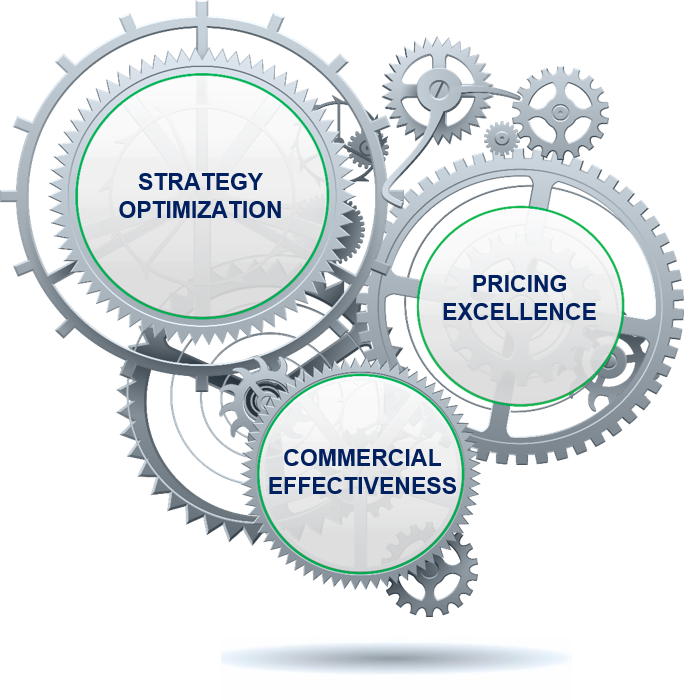

Ahead of the B2B Pricing & Commercial Excellence Summit America 2026, Fernando Ventureira explores why sustainable competitive advantage depends on integrating pricing strategy, commercial execution, governance, and decision intelligence into one commercial operating framework.
Most Organizations Do Not Have a Pricing Problem. They Have a Decision-Making Problem.
In September 2026, Stratence Partners will participate in the B2B Pricing & Commercial Excellence Summit America in New York, where Fernando Ventureira, CEO of Stratence Partners, will deliver the Closing Keynote:
"From Strategy to Sustainable Competitive Edge: Commercial Transformation in Practice."
The session will address a challenge that continues to limit performance across many organizations.
Most organizations do not have a pricing problem.
They have a decision-making problem.
Across industries, organizations continue investing in pricing initiatives, commercial excellence programs, AI capabilities, data platforms, and transformation agendas.
Yet many executive teams continue asking the same question:
Why does sustainable performance remain so difficult to achieve?
The answer is often surprising.
The issue is rarely pricing itself.
Nor is it usually commercial execution, data availability, organizational capability, or technology.
The challenge lies in the way decisions are made.
Many organizations operate with strong individual functions, but without a unified framework connecting strategic priorities, pricing economics, commercial execution, governance, and performance management.
Each function improves independently.
The organization as a whole does not.
As a result, significant opportunities remain unrealized despite substantial investment and effort.
This is why Commercial Transformation is increasingly becoming a leadership discipline rather than a collection of initiatives.
The Hidden Cost of Fragmented Decision-Making
Most organizations do not suffer from a lack of intelligence.
They suffer from fragmented intelligence.
Pricing teams optimize margins.
Commercial teams pursue growth.
Finance protects profitability.
Operations focus on efficiency.
Strategy teams define future direction.
Each function contributes value.
The challenge emerges when decisions across these functions are not aligned.
The result is often:
Inconsistent pricing execution
Margin leakage hidden across the commercial waterfall
Slow response to market opportunities
Limited visibility into profitability drivers
Difficulty scaling successful initiatives
Reduced organizational agility
These issues rarely appear as isolated problems.
They emerge as structural barriers that limit sustainable performance.
Competitive Advantage Is Created Through Integrated Decisions
The organizations generating the most consistent commercial results are not necessarily those with the most advanced pricing models or the largest transformation budgets.
They are the organizations that have developed an integrated decision architecture.
An integrated framework aligns:
Strategic objectives
Pricing economics
Commercial execution
Data transparency
Governance disciplines
Organizational ownership
When these elements operate together, decisions become faster, more consistent, and more effective.
The organization gains the ability to translate strategy into measurable business outcomes.
Not occasionally.
Systematically.
Why Pricing Excellence Must Be Connected to Commercial Excellence
Pricing excellence creates value.
Commercial excellence captures value.
Neither can reach full potential without the other.
Organizations frequently improve pricing capabilities while leaving execution models unchanged.
Others strengthen sales execution while maintaining outdated pricing governance.
The highest-performing organizations recognize that sustainable improvement requires both disciplines working within a common operating framework.
This creates:
Greater pricing consistency
Stronger negotiation authority
Improved customer profitability
Faster decision-making
Better cross-functional alignment
More sustainable performance improvement
The objective is not simply to optimize pricing.
The objective is to improve how the organization makes commercial decisions.
Case Example
A global B2B industrial organization had invested heavily in pricing tools, commercial analytics, and sales enablement initiatives.
Despite these investments, profitability improvements remained inconsistent across regions.
The organization launched a Commercial Transformation program focused on aligning pricing governance, commercial execution, profitability transparency, and decision ownership.
The initiative introduced:
Integrated pricing governance
Gross-to-net visibility across business units
Standardized commercial decision processes
Enhanced accountability structures
Cross-functional performance management
Within twelve months:
Pricing consistency improved significantly
Commercial decision cycles were reduced by more than 35%
Margin performance increased by 6%
Commercial investments became more targeted
Leadership teams gained greater visibility into profitability drivers
Most importantly, the organization established a repeatable operating model capable of sustaining future performance improvements.
Conclusion
At the upcoming B2B Pricing & Commercial Excellence Summit America 2026, -by Ardensi- one of the central themes of Fernando Ventureira's Closing Keynote will be that sustainable competitive advantage rarely comes from isolated excellence.
It comes from integrated excellence.
Organizations that connect pricing strategy, commercial execution, governance, and decision intelligence create a structural advantage that competitors find difficult to replicate.
The question for executive teams is increasingly straightforward:
Is your organization optimizing functions, or optimizing decisions?


Comments